嘥
Character Story & Explanation
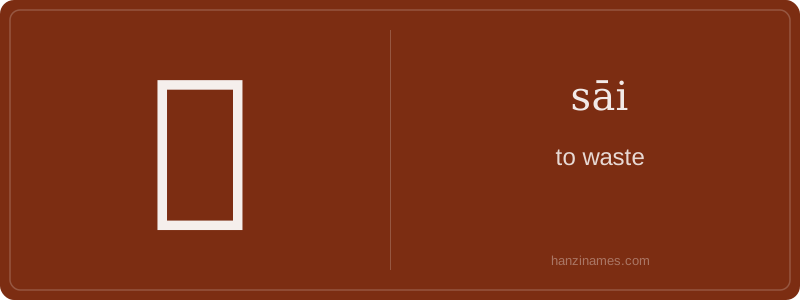
嘥 is a Cantonese-specific character with documented use since at least the early 20th century in vernacular publications and opera scripts. It appears frequently in Hong Kong newspapers, TV subtitles, and digital communication — especially in admonitory phrases like ‘嘥心機’ (sāi sām gī, ‘waste effort’) and ‘嘥氣’ (sāi hei, ‘waste breath’). Linguists classify it as a phonosemantic compound, not an ancient pictograph; its left side 口 (mouth radical) signals speech-related or expressive action, while the right side 斯 (sī) provides phonetic cue — though pronunciation shifted to sāi in Yue dialects.
The character has no oracle bone or bronze script origin — it emerged later as a dialectal orthographic innovation. Today, Cantonese speakers use it daily in casual warnings and self-reflection: ‘我今日又嘥咗三小時’ (I wasted another three hours today). It rarely appears in formal Mandarin writing, confirming its role as a living, regional lexical marker.
Hi there! Let’s talk about the character 嘥 (sāi), which means 'to waste' — especially time, energy, or resources in a careless or avoidable way. It’s not a formal textbook character in standard Mandarin teaching materials, but it’s widely used in spoken and written Cantonese. Don’t worry if you haven’t seen it in your HSK textbooks — that’s because it’s regionally dominant, not nationally standardized. Still, understanding it helps you grasp authentic everyday speech across southern China and Hong Kong.
This character carries a gentle scolding tone — like a parent saying, 'Don’t waste your youth!' or friends teasing, 'Why 嘥 time on that?' It’s more colloquial and emotive than the standard Mandarin word 浪费 (làngfèi), which sounds more neutral or official. Pronounced sāi with first tone, it rhymes with ‘sky’ — think: 'Sigh… don’t waste!' — helping you remember both sound and meaning.
While 嘥 isn’t in the HSK lists (so no official level), it’s extremely common in Cantonese media, social posts, and conversation. You’ll see it in slogans like ‘唔好嘥時間!’ (m̀h houh sāi sihk gàn!) — ‘Don’t waste time!’ — often paired with exclamation marks for urgency. Its informal warmth makes it feel personal and real — less like grammar, more like life advice from your auntie. That’s why learning it deepens cultural fluency, even if it won’t appear on your next HSK exam.
Example Sentences
Common Compounds
Similar Characters — Don't Mix These Up
Your First Step into Chinese Culture: Get a Chinese Name
Every journey into Chinese begins with a name. Use our free Chinese name generator to create a meaningful, personalized Chinese name that fits you perfectly.
Get My Chinese Name →