嘬
Character Story & Explanation
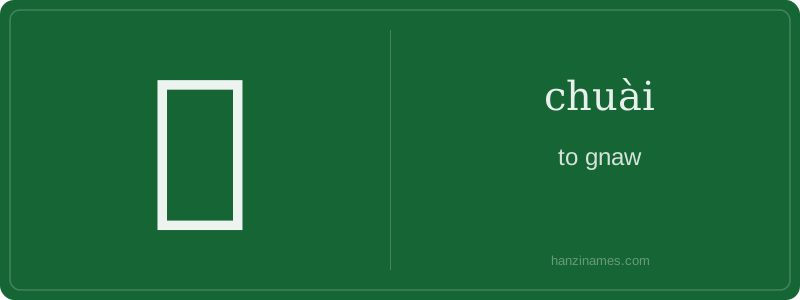
嘬 is rarely used in formal writing but remains common in spoken Mandarin, especially in northern dialects and informal contexts. It appears in phrases like 嘬奶 (zuō nǎi, 'to suckle') and 嘬手指 (zuō shǒuzhǐ, 'to suck one's thumb'), and is frequently heard in parenting, medical, or culinary descriptions. Though not in the HSK syllabus (HSK Level: Not included), it’s widely understood and occasionally taught in advanced character courses for its expressive power and phonetic regularity.
The character combines 口 (mouth) on the left and 最 (zuì, 'most') on the right—a phonetic-semantic compound. 最 originally meant 'topmost' or 'utmost' and here serves mainly as a sound hint (zuō/zuì share historical phonetic roots). There is no pictographic origin; it emerged in later clerical script as a specialized mouth-action verb, reflecting linguistic refinement rather than ancient imagery.
The Chinese character 嘬 (chuài, also zuō) is a vivid, mouth-centered verb meaning 'to gnaw', 'to suck noisily', or 'to sip with puckered lips'. Unlike English verbs like 'sip' or 'chew', 嘬 emphasizes the physical action of drawing something in with strong lip and tongue movement—often implying effort, intimacy, or even rudeness depending on context. It belongs to the 口 (mouth) radical family, signaling its connection to oral activity, and appears in both literary and colloquial registers.
Compared to Western equivalents, 嘬 has no direct one-word counterpart. 'Gnaw' suggests slow, persistent chewing (like rodents), while 'suck' is broader but lacks the lip-focused nuance. In English, we might say 'suck noisily on a lollipop' or 'gnaw at a bone'—but 嘬 condenses that tactile, auditory, and kinetic quality into a single character. It evokes sound and sensation more than abstract action, aligning with Chinese’s tendency to encode embodied experience linguistically.
Culturally, 嘬 reflects a linguistic sensitivity to bodily micro-behaviors often overlooked in English. Where Western descriptions may prioritize intention ('she drank the tea') or result ('the bone was chewed'), 嘬 foregrounds *how* the mouth engages: the slight pucker, the suction, the rhythmic pulling. This mirrors broader East Asian aesthetic values—attentiveness to subtle gesture, presence in the moment, and respect for the physicality of daily acts like eating, drinking, or even comforting a child.
Example Sentences
Common Compounds
Similar Characters — Don't Mix These Up
Your First Step into Chinese Culture: Get a Chinese Name
Every journey into Chinese begins with a name. Use our free Chinese name generator to create a meaningful, personalized Chinese name that fits you perfectly.
Get My Chinese Name →