嘭
Character Story & Explanation
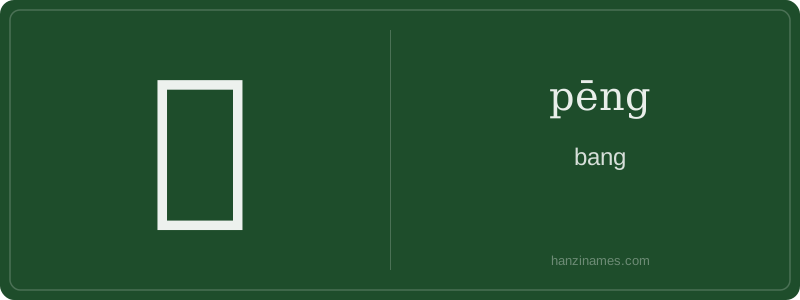
嘭 is overwhelmingly used in modern Chinese fiction, film subtitles, comics, and oral narration to depict abrupt, loud noises — especially in children’s books, martial arts novels, and animated shows. It appears in standardized textbooks like *HSK Standard Course* (Level 3+ supplementary materials) as an example of onomatopoeia, though it’s not HSK-listed. No classical idiom features 嘭; it’s absent from the *Chengyǔ* corpus. Real-world usage peaks in descriptive writing: ‘嘭的一声’ (pēng de yī shēng) — ‘with a bang’ — is a fixed, high-frequency phrase taught in middle-school Chinese classes.
The character has no oracle-bone or bronze script form — it’s a late creation. Its documented origin lies in Song–Ming vernacular printing, where printers adapted 彭 (already associated with booming sounds) by adding 口 to clarify its function as vocalized onomatopoeia. This reflects a broader trend: late-imperial scribes often doubled radicals (e.g., 哗, 咚) to intensify sonic meaning.
As a detective tracing 嘭’s evolution, I begin at its radical: 口 (kǒu), the ‘mouth’ or ‘speech’ component — a telltale sign this character represents sound, not object or action. Unlike pictographic characters carved from nature, 嘭 is phonosemantic: 口 signals auditory meaning, while the right side 彭 (péng) provides both pronunciation and onomatopoeic resonance — 彭 itself historically denoted a deep, resonant boom, appearing in ancient texts like the *Shuōwén Jiězì* (c. 100 CE) as a ‘sound of drumming’.
Zooming in on 彭, its earliest forms combine 巽 (xùn, originally ‘wind’ or ‘penetrating force’) and 豕 (shǐ, ‘pig’), but by the Han dynasty, 彭 had solidified as an independent phonetic element for explosive, percussive sounds — think temple drums or collapsing beams. 嘭 emerged later, likely during the Ming–Qing vernacular fiction boom, when writers needed vivid, colloquial onomatopoeia for gunshots, doors slamming, or fireworks — hence the extra 口 stroke to heighten vocal immediacy.
This character never appears in classical poetry or formal edicts; it’s a child of spoken language, born in storytelling and theater. Its 15 strokes reflect deliberate visual amplification: the 口 radical is slightly enlarged, and the 彭 component is written with full, emphatic strokes — no cursive shortcuts. That very ‘heaviness’ mirrors its semantic weight: not just any noise, but a sudden, physical, room-shaking *bang*. It’s linguistic staging — punctuation made glyph.
Example Sentences
Common Compounds
Similar Characters — Don't Mix These Up
Your First Step into Chinese Culture: Get a Chinese Name
Every journey into Chinese begins with a name. Use our free Chinese name generator to create a meaningful, personalized Chinese name that fits you perfectly.
Get My Chinese Name →