叽
Character Story & Explanation
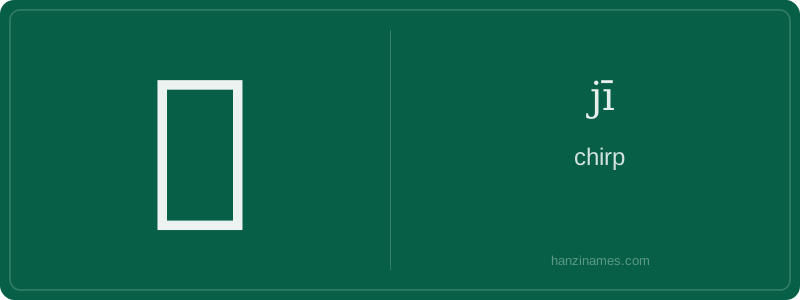
In modern Chinese, 叽 appears overwhelmingly in reduplicated onomatopoeic forms like 叽叽、叽叽喳喳 (jī jī zhā zhā), meaning 'chirping' or 'chattering noisily.' It’s common in children’s literature, cartoons, and descriptive writing—for example, describing sparrows, gossiping classmates, or background café murmur. It does not appear in formal documents or classical poetry as a standalone verb meaning 'to grumble'; that sense is rare and colloquial. The HSK does not include 叽 as a required character, reflecting its peripheral status in standardized learning.
The character’s written form is not pictographic—it evolved from seal script where 口 (mouth) combined with 几 (a phonetic component, pronounced jī). 几 originally depicted a low sitting stool but lost its pictorial meaning here, serving only to signal pronunciation. No oracle bone or bronze inscription evidence exists for 叽; its earliest attestation is in late imperial vernacular texts like *The Plum in the Golden Vase* (16th c.), used exclusively for sound imitation.
As an archaeologist sifting through layers of linguistic sediment, I find 叽 not in oracle bones—but in the living soil of spoken Chinese. Its five strokes form a modest yet resonant glyph: the mouth radical 口 anchors it firmly in vocalization, while the right component 几 (jī) originally denoted a low table—here repurposed phonetically. This is not a pictograph of grumbling, but a phonosemantic compound: sound + category. Its earliest documented uses appear in Ming-Qing vernacular fiction, where it mimics soft, repetitive vocalizations—not rage, but restless murmuring.
The character’s modesty belies its semantic precision. Unlike 大声抱怨 (shouting complaints), 叽 conveys quiet, often trivial, persistent complaint—like a child fussing over socks or colleagues muttering about coffee quality. It carries tonal nuance: the first tone (jī) lends it a clipped, almost mechanical quality, reinforcing its association with habitual, low-volume dissent. In classical texts, it rarely appears alone; it thrives in reduplicated forms like 叽叽, echoing the rhythmic repetition of actual grumbling—a linguistic onomatopoeia refined over centuries.
What makes 叽 archaeologically fascinating is its resistance to moral judgment. Unlike 怨 (yuàn, deep resentment) or 恨 (hèn, hatred), 叽 is emotionally lightweight—almost affectionate in context. Parents say 小鸟叽叽叫 (xiǎo niǎo jī jī jiào) for ‘chirping birds,’ extending its vocal texture to harmless, even endearing sounds. This semantic elasticity reveals a cultural tolerance for benign dissent: grumbling isn’t rebellion—it’s human rhythm. The character thus functions less as a lexical unit and more as a phonetic brushstroke, coloring speech with texture, volume, and social register.
Example Sentences
Common Compounds
Similar Characters — Don't Mix These Up
Your First Step into Chinese Culture: Get a Chinese Name
Every journey into Chinese begins with a name. Use our free Chinese name generator to create a meaningful, personalized Chinese name that fits you perfectly.
Get My Chinese Name →