哓
Character Story & Explanation
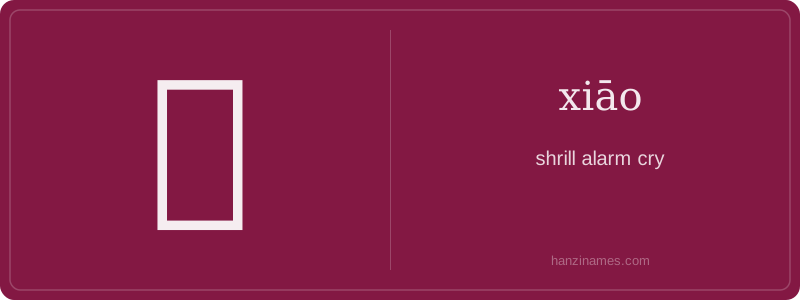
哓 is rarely used alone in modern Mandarin but appears predominantly in the fixed literary phrase 哓哓不休 (xiāo xiāo bù xiū), meaning 'to chatter incessantly' or 'to nag persistently' — often with connotations of shrill, unwarranted alarm or pedantic insistence. It appears in classical texts like the *Book of Songs* (Shījīng) and later in essays by Lu Xun, who used 哓哓 to satirize dogmatic, loudmouthed ideologues. The phrase remains current in formal writing and media criticism.
The character’s form combines 口 (mouth) and 堯 (yáo, originally depicting a tall platform or elevated person, later phonetic). Per the *Shuōwén Jiězì* (121 CE), 哓 is defined as ‘shouting loudly’, confirming its early association with forceful, attention-grabbing vocalization — not mere noise, but urgent utterance.
The character 哓 (xiāo) embodies a distinctly human moment: the sharp, involuntary cry that pierces silence at the first sign of danger. Unlike calm speech or reasoned argument, 哓 captures urgency — not just sound, but alarm encoded in phonetics and form. Its mouth radical (口) anchors it in vocalization, while the right component (堯) historically evokes elevation and prominence — suggesting a voice raised high, piercing the air like a warning beacon. This reflects a Chinese worldview where language is not merely descriptive but performative: a cry can halt action, summon help, or mark a threshold between safety and peril.
In classical Chinese thought, sound carries moral and cosmological weight — the ‘right’ tone aligns with harmony (和), while dissonant cries like 哓 signal imbalance or rupture. Thus, 哓 is never neutral; it implies disruption demanding response. Its rarity in modern daily speech underscores its semantic gravity: it’s reserved for literary, rhetorical, or heightened contexts — not casual chatter. This restraint mirrors Confucian ideals of measured expression, where even alarm is voiced with intentionality, not panic.
Etymologically, 哓 belongs to a family of onomatopoeic and affective sound-words (e.g., 吵 chǎo, 啼 tí) that map emotional states onto articulation. Its nine-stroke structure balances visual simplicity with expressive density — a compact vessel for visceral human reaction. In Daoist terms, it echoes the ‘uncarved block’ (樸): raw, unmediated vocal energy before rational framing. To study 哓 is thus to glimpse how Chinese script encodes not just meaning, but embodied response — where writing preserves the tremor of a throat tightening at the edge of danger.
Example Sentences
Common Compounds
Similar Characters — Don't Mix These Up
Your First Step into Chinese Culture: Get a Chinese Name
Every journey into Chinese begins with a name. Use our free Chinese name generator to create a meaningful, personalized Chinese name that fits you perfectly.
Get My Chinese Name →