噀
Character Story & Explanation
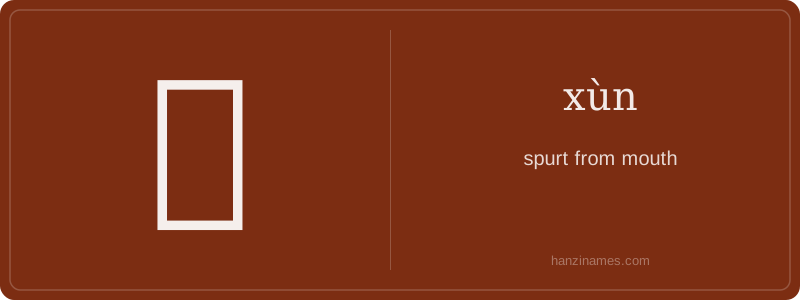
噀 is rarely used in contemporary spoken Mandarin but persists in classical texts, martial arts novels, and traditional opera scripts—especially in descriptions of Daoist rituals or heroic defiance. A documented usage appears in the Ming-dynasty novel Fengshen Yanyi (Investiture of the Gods), where immortals '噀一口真气' (xùn yī kǒu zhēn qì, 'spurt a mouthful of genuine qi') to animate talismans or repel demons. It also appears in Qing-era medical texts describing pathological 'spurting of blood from mouth' (噀血).
The character is a phono-semantic compound: 口 (kǒu, 'mouth') is the semantic radical, indicating oral action; the phonetic component is 侚 (xùn), now obsolete as an independent character but historically signaling pronunciation. No oracle-bone or bronze inscription evidence exists for 噀—it first appears reliably in Han dynasty lexicons like Shuōwén Jiězì, classified under 口部 (mouth radical), confirming its lexical origin as a deliberate, learned creation for precise literary expression.
噀 (xùn) is a classical Chinese verb meaning 'to spurt or spray from the mouth'—often with force, drama, or supernatural connotation. It appears almost exclusively in literary, historical, or performative contexts, not in modern colloquial speech. Unlike common verbs like 吐 (tǔ, 'to spit') or 喷 (pēn, 'to spray'), 噀 carries an archaic, vivid, and sometimes theatrical weight—evoking images of Daoist priests blowing talismanic breath or warriors spitting blood in defiance.
This character reflects a deeply embodied cultural view of breath and oral emission as potent, ritualized acts. In traditional Chinese cosmology, the mouth is not just an organ but a conduit for qi, spells, and moral force—so 'spurting' isn’t merely physical but semiotically charged. Western equivalents like 'spew', 'gush', or 'expel' lack this metaphysical layer; even Shakespearean 'spout' or 'vomit forth' emphasize disgust or excess, not sacred agency.
Culturally, 噀 aligns more closely with ritual utterances in Western esoteric traditions—like the priestly 'exsufflation' (blowing away evil spirits in medieval baptism rites) or the incantatory 'hiss' in Greek magical papyri—than with everyday English verbs. Its rarity today underscores how Chinese retains highly specialized characters for precise semantic and stylistic nuance, especially in preserving classical register across literature, opera, and religious texts.
Example Sentences
Common Compounds
Similar Characters — Don't Mix These Up
Your First Step into Chinese Culture: Get a Chinese Name
Every journey into Chinese begins with a name. Use our free Chinese name generator to create a meaningful, personalized Chinese name that fits you perfectly.
Get My Chinese Name →