噎
Character Story & Explanation
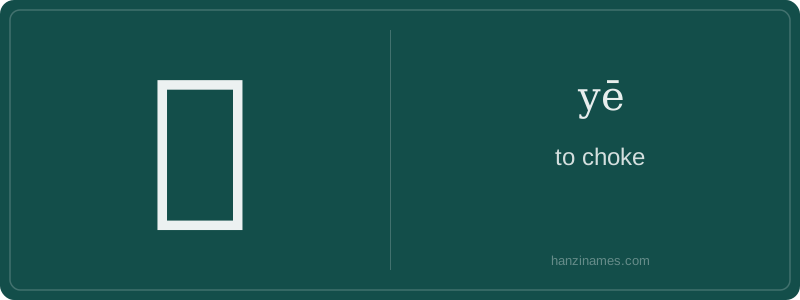
噎 is commonly used in modern Mandarin in health advisories (e.g., '吃饭别太急,小心噎着' — 'Don’t eat too fast; watch out for choking'), parenting language, and literature to depict abrupt emotional silencing. It appears in the idiom 噎得说不出话 (yē de shuō bu chū huà) — 'choked into silence' — widely cited in contemporary novels and news reports describing shock or grief. The phrase 噎食 (yēshí) — 'choking on food' — is standard in public safety campaigns across China.
The character’s form combines 口 (kǒu, 'mouth') and 殹 (yē), a phonetic component derived from ancient scripts where the right side suggested constriction or obstruction. Though not a pictograph, its structure visually echoes the mouth ‘constricted’ by an internal block—consistent with its semantic function. No oracle-bone or bronze inscriptions of 噎 survive, but its earliest attested use dates to the Ming dynasty in vernacular texts describing dysphagia.
噎 (yē) is a vivid, action-oriented character meaning 'to choke'—specifically the sudden, involuntary stoppage of breathing or swallowing, often due to food, emotion, or shock. Its radical 口 (mouth) anchors it in bodily experience, while the phonetic component 殹 (yē) hints at pronunciation and historically relates to sound obstruction. Unlike generic 'swallowing' verbs, 噎 carries urgency and physical discomfort, making it essential for describing real-life choking incidents or emotional speech blockage.
In Chinese usage, 噎 frequently appears in both literal and figurative contexts: from medical warnings about eating too fast to literary depictions of grief-stifled speech. It’s more visceral than synonyms like 卡 (qiǎ, 'to get stuck') or 塞 (sāi, 'to block'), emphasizing involuntary physiological reaction rather than mechanical obstruction. This nuance reflects how Chinese lexicalizes embodied experience with precision.
Compared to Western equivalents, 'choke' in English spans physical suffocation, emotional suppression ('choked up'), and even competitive pressure ('choked under pressure'). 噎 mirrors this breadth but leans more strongly toward immediate physical sensation—and less toward metaphorical failure. While English speakers might say 'I choked on my words', Chinese prefers 噎住 (yē zhù) for that exact moment of vocal arrest, preserving cultural emphasis on somatic authenticity over abstract performance anxiety.
Example Sentences
Common Compounds
Similar Characters — Don't Mix These Up
Your First Step into Chinese Culture: Get a Chinese Name
Every journey into Chinese begins with a name. Use our free Chinese name generator to create a meaningful, personalized Chinese name that fits you perfectly.
Get My Chinese Name →