噔
Character Story & Explanation
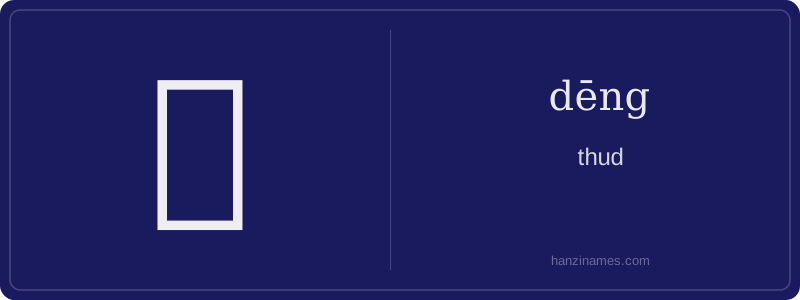
噔 is almost exclusively used in modern Mandarin as an onomatopoeic interjection, appearing in spoken dialogue, comics (manhua), subtitles, and children’s literature to convey sharp, heavy impacts — especially footsteps, doors closing, or objects dropping. It appears in no classical texts or pre-20th-century dictionaries. Its earliest documented usage is in early 20th-century vernacular fiction, gaining frequency with the rise of audio-visual media. While absent from idioms (chengyu), it frequently appears in reduplicated form (噔噔) in colloquial speech and writing to intensify rhythm and affect.
The character is not pictographic or ideographic in origin — it was deliberately constructed in the late imperial or early Republican era by combining 口 (mouth, indicating sound) with 登 (dēng, 'to ascend', serving phonetically). This is a classic phono-semantic compound (xíngshēng zì), where 登 provides pronunciation and 口 signals semantic domain. No oracle bone or bronze script forms exist; it is a modern orthographic invention for a newly codified sound.
噔 (dēng) is not a lexical word in classical Chinese but a modern onomatopoeic character — a sonic artifact of linguistic evolution. Its existence reflects the Chinese worldview that language must mirror lived sensory experience: sound, weight, and suddenness are not abstract but embodied and vocalizable. The mouth radical (口) signals its origin in utterance — not thought or logic, but the physical act of voicing impact. This prioritizes phenomenology over semantics: meaning arises first from how something *feels* to hear and say.
In Chinese aesthetic and philosophical tradition, abrupt sounds like 噔 carry cosmological resonance — echoing the Daoist ‘sudden stillness after motion’ or Chan Buddhist ‘shout’ (喝, hē) that jolts awareness. A thud isn’t mere noise; it marks a boundary crossing: foot hitting floor, door slamming shut, a realization dropping into consciousness. Thus, 噔 embodies the cultural reverence for decisive moments — where silence fractures, and presence asserts itself.
Unlike English onomatopoeia, which often stays marginal, Chinese integrates such characters into expressive grammar: reduplicated as 噔噔 (dēng dēng), it gains rhythm and emotional texture — urgency, impatience, or comic timing. This reveals a linguistic culture where sound *structures* meaning as much as syntax does. 噔 thus becomes a microcosm of Chinese semiotics: meaning emerges not just from definition, but from repetition, context, bodily gesture, and the visceral weight of air expelled through the mouth.
Example Sentences
Common Compounds
Similar Characters — Don't Mix These Up
Your First Step into Chinese Culture: Get a Chinese Name
Every journey into Chinese begins with a name. Use our free Chinese name generator to create a meaningful, personalized Chinese name that fits you perfectly.
Get My Chinese Name →