噗
Character Story & Explanation
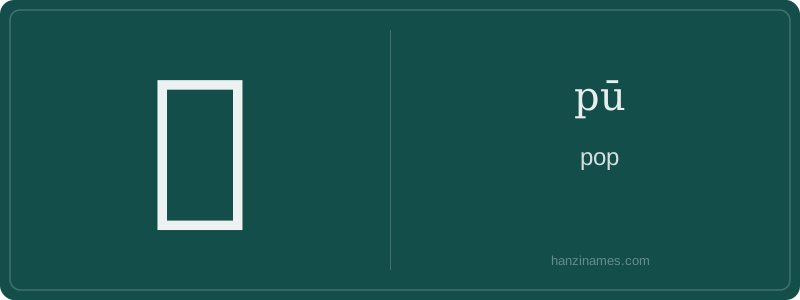
噗 is overwhelmingly used in modern Mandarin as an onomatopoeic interjection — not in formal writing or classical texts, but in dialogue, comics, social media, and spoken narration. It appears frequently in novels (e.g., Mo Yan’s works) and animated subtitles to depict sudden, light bursts: a cork popping, a bubble bursting, or someone exhaling dismissively. No major idiom or成语 features 噗; it’s too colloquial and phonetic for fixed expressions. Historically, it’s absent from pre-Qing dictionaries and only entered widespread use in the 20th century with vernacular literature and audiovisual media.
The character has no documented pictographic origin — it’s purely phonosemantic, created by combining 口 (mouth/sound) with 普 (for pronunciation). In daily life, Chinese speakers use it spontaneously: typing ‘噗’ in WeChat to mock a silly claim, or shouting it playfully when blowing out candles. Its power lies in immediacy — it’s never written without intent to evoke sound and reaction.
As a detective tracing 噗’s evolution, I begin with its radical: 口 (kǒu), the 'mouth' component — a clear signal this character is phonetic and onomatopoeic, rooted in vocalization. Its right side, 普 (pǔ), provides the sound clue — though slightly altered to pū, it preserves the core ‘pu’ articulation. Unlike ancient pictographs, 噗 emerged relatively late in Chinese orthography, not appearing in oracle bone or bronze inscriptions; it’s a post-classical creation designed specifically to capture a sharp, explosive oral sound.
This character is a textbook example of a ‘phonosemantic compound’ where meaning and sound converge: 口 signals speech/sound production, while 普 — though semantically unrelated to ‘pop’ — was co-opted for its phonetic proximity. Over centuries, scribes simplified and standardized its form, settling on the modern 15-stroke structure we see today. Its lack of early attestation confirms it wasn’t conceptualized as a philosophical or ritual term, but as a practical tool for transcribing spontaneous, bodily sounds — like air escaping or bubbles bursting.
Crucially, 噗 never developed abstract meanings like many characters did (e.g., 明 ‘bright’ → ‘understanding’). It remains stubbornly literal and performative — always tied to audible, momentary release. That linguistic fidelity makes it unusually stable across dialects and time: whether in Tang dynasty poetry fragments (rare) or modern web slang, 噗 consistently mimics that single, percussive ‘pffft-pop’ — a sonic fingerprint preserved in ink.
Example Sentences
Common Compounds
Similar Characters — Don't Mix These Up
Your First Step into Chinese Culture: Get a Chinese Name
Every journey into Chinese begins with a name. Use our free Chinese name generator to create a meaningful, personalized Chinese name that fits you perfectly.
Get My Chinese Name →