噘
Character Story & Explanation
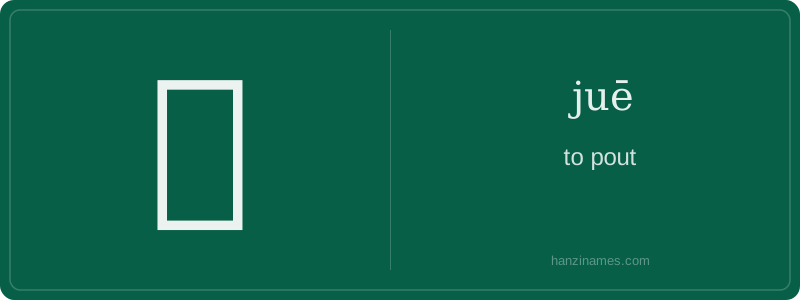
噘 is widely used in modern spoken and literary Mandarin to depict lip-protruding expressions of displeasure, sulkiness, or coyness—especially in dialogue and descriptive prose. It appears in contemporary novels (e.g., works by Eileen Chang), parenting guides, and media subtitles. While no classical idiom centers solely on 噘, it commonly appears in compound verbs like 噘嘴 (juē zuǐ, 'to pout') and phrases such as '噘着嘴' ('with lips pouted'). Documented usage surged in 20th-century vernacular literature as part of the broader shift toward expressive colloquial writing.
The character is a phono-semantic compound: 口 (kǒu, 'mouth') is the semantic radical, clearly indicating its connection to oral expression; 屈 (qū, 'to bend, yield') serves as the phonetic component, approximating the pronunciation juē (though tone and vowel differ slightly—a common phenomenon in Chinese character evolution). No oracle-bone or bronze inscription evidence exists for 噘; it emerged later in the written vernacular tradition, likely during the Ming–Qing period, reflecting everyday speech.
Imagine a rainy afternoon in Beijing’s Nanluoguxiang alley, where a six-year-old girl named Xiao Mei stands arms crossed, lips thrust forward like a tiny cherry pit—her mouth puckered into a perfect, stubborn pout. Her grandmother kneels beside her, gently coaxing: 'Don’t juē—your face will stick like that!' This vivid gesture—mouth pushed outward in silent protest or sulky disappointment—is precisely what 噘 captures. It’s not just facial movement; it’s emotional grammar, signaling hurt pride, refusal, or playful petulance without a single word.
Unlike generic words for ‘frown’ or ‘scowl’, 噘 is hyper-specific: it describes the deliberate, often childish or affectionately exasperating act of protruding the lips. It appears frequently in spoken Mandarin and informal writing—novels, parenting blogs, even viral Douyin captions—but is rarely used in formal documents or academic texts. Its phonetic-semantic structure (口 + 屈) reinforces this: the ‘mouth’ radical signals speech/face, while 屈 (qū, ‘to bend’ or ‘submit’) hints at suppressed emotion bending outward physically.
This character thrives in interpersonal nuance. A parent might say ‘别噘嘴了’ (‘Stop pouting!’) with soft scolding; a teen might text ‘他刚才噘着嘴走了’ (‘He walked off pouting’) to convey theatrical indignation. It’s emotionally legible across generations—not because it’s ancient, but because the universal language of the pout needs no translation. In Chinese, 噘 gives that silent, lip-driven sigh its name, voice, and cultural weight.
Example Sentences
Common Compounds
Similar Characters — Don't Mix These Up
Your First Step into Chinese Culture: Get a Chinese Name
Every journey into Chinese begins with a name. Use our free Chinese name generator to create a meaningful, personalized Chinese name that fits you perfectly.
Get My Chinese Name →