哕
Character Story & Explanation
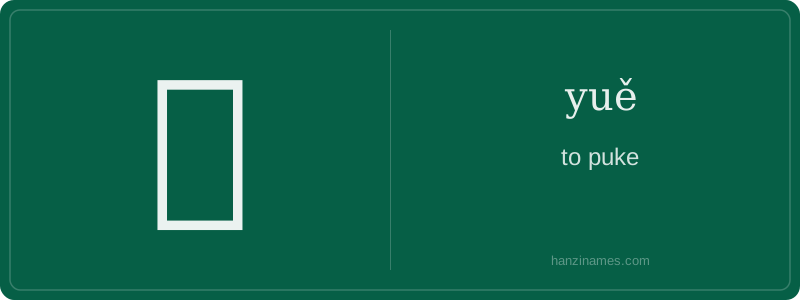
哕 is virtually absent from spoken Mandarin today. It survives primarily in Traditional Chinese Medicine (TCM) terminology and classical or literary contexts — e.g., in diagnostic phrases like '干哕' (gān yuě, 'dry heaving') in medical classics. It appears in the Shanghan Lun (Treatise on Cold Damage, c. 200 CE) describing symptoms of stomach qi rebellion. Modern doctors use 吐 or 恶心 instead; 哕 is reserved for precise, formal, or stylistic effect.
The character is not pictographic — no oracle bone or bronze script forms survive. Its earliest attested form is in seal script (c. 3rd century BCE), already composed of 口 + 岳. The right side 岳 is phonetic only; the character was invented to write the existing word yuě, not to depict vomiting visually. Today, it’s most likely encountered by students reading classical medicine or studying rare literary vocabulary.
Our detective work begins at the crime scene: the character 哕. At first glance, it’s a mouth (口) doing something violent — and indeed, its core meaning is visceral: to retch or puke. The right-hand component, 岳 (yuè), isn’t a mountain here — it’s purely phonetic, borrowed for its sound, not its meaning. This is classic phono-semantic compounding: 口 signals the domain (oral, bodily emission), while 岳 hints at pronunciation. No ancient pictograph of vomiting exists — this is a later, literate creation.
Historically, 哕 appears in classical medical texts like the Huangdi Neijing (Yellow Emperor’s Inner Canon), where it describes pathological upward qi movement — nausea preceding vomiting. It’s never casual slang; rather, it's clinical, literary, or archaic. Unlike common verbs like 吐 (tǔ), 哕 carries a sharp, almost onomatopoeic edge — evoking the guttural, involuntary sound of heaving. Its rarity today reflects how medical language evolved away from such vivid monosyllables.
Modern usage is highly constrained: you’ll rarely hear it in speech, but you may encounter it in TCM (Traditional Chinese Medicine) diagnoses, literary descriptions of illness, or satirical writing mimicking classical diction. It’s not in the HSK syllabus — not because it’s unimportant, but because it’s too specialized. Learners won’t need it for daily conversation, but recognizing it reveals how Chinese encodes physiology through sound, structure, and semantic framing — a linguistic autopsy of bodily distress.
Example Sentences
Common Compounds
Similar Characters — Don't Mix These Up
Your First Step into Chinese Culture: Get a Chinese Name
Every journey into Chinese begins with a name. Use our free Chinese name generator to create a meaningful, personalized Chinese name that fits you perfectly.
Get My Chinese Name →