嚆
Character Story & Explanation
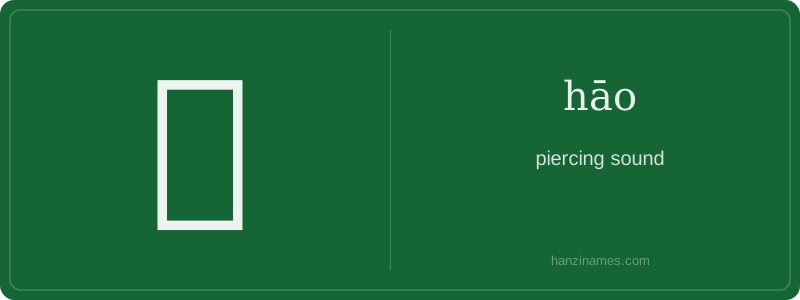
嚆 is almost exclusively used in the idiom 嚆矢 (hāo shǐ), meaning 'a guiding arrow' or metaphorically 'a forerunner, harbinger'. First recorded in the pre-Qin text Zhuangzi (c. 4th–3rd century BCE), it describes an arrow fired ahead to mark direction—its sharp 'hāo' sound signaling the path. Today, 嚆矢 appears in formal writing, journalism, and political discourse to denote pioneering initiatives (e.g., 'the policy is a 嚆矢 for reform'). It is never used alone in speech or casual text.
The character combines 口 (radical, indicating sound-related meaning) and 皐 (gāo, phonetic component, now obsolete as an independent character). Its structure reflects ancient Chinese phonosemantic compound design—no pictographic origin exists; it was created c. Han dynasty for literary precision, not visual representation.
The character 嚆 (hāo) is a rare, literary word meaning 'a sharp, piercing sound'—especially one that signals the start of something, like a whistle or alarm. It belongs to the 口 (mouth/sound) radical family, indicating its phonetic and semantic link to vocalization or auditory phenomena. Though not part of modern spoken Chinese, it survives in classical texts and formal writing to evoke urgency or initiation.
In English, no single word maps perfectly onto 嚆: 'whistle' is too specific, 'alarm' too functional, and 'cry' too emotional. Its nuance lies in being *both* acoustic and symbolic—a sonic herald. Think of a starting pistol at a race: the sound itself isn’t just noise; it’s the official beginning. This dual function—sound as signal—is central to 嚆’s usage.
Western equivalents include Latin ‘vox’ (voice) in rhetorical contexts or Greek ‘kerygma’ (proclamation), but those emphasize message over acoustics. Closer parallels exist in onomatopoeic literary devices—like T.S. Eliot’s 'The hollow men' whispering 'not with a bang but a whimper'—where sound marks transition. Yet 嚆 carries more authority and ceremonial weight, akin to a bugle call in military tradition or the shofar blast in Jewish High Holy Days: brief, sharp, and ritually decisive.
Example Sentences
Common Compounds
Similar Characters — Don't Mix These Up
Your First Step into Chinese Culture: Get a Chinese Name
Every journey into Chinese begins with a name. Use our free Chinese name generator to create a meaningful, personalized Chinese name that fits you perfectly.
Get My Chinese Name →