哜
Character Story & Explanation
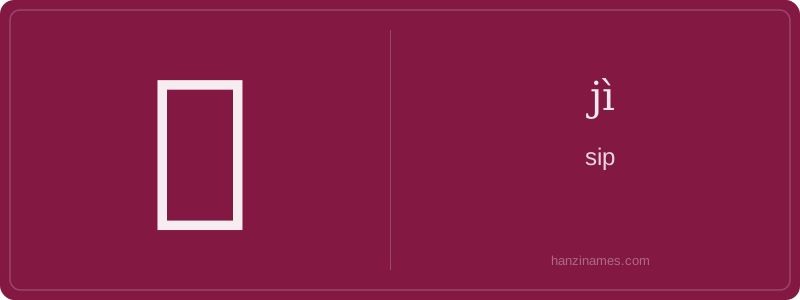
哜 is virtually absent from modern spoken Mandarin and does not appear in the HSK syllabus (HSK Level: Not included). It survives almost exclusively in classical literature, historical reenactments, and formal poetry—especially in phrases like 哜酒 (jì jiǔ), meaning 'to ritually sip wine' during Zhou- and Han-dynasty ancestral ceremonies. The *Rites of Zhou* (Zhōu Lǐ) explicitly prescribes 哜 for the 'third sip' in the three-stage libation rite, distinguishing it from initial tasting (嘗, cháng) and final offering (祭, jì).
The character’s form shows no oracle-bone or bronze script attestation; it first appears in Warring States bamboo manuscripts and early Han seal script. Its right side 齊 is not pictographic here but phonetic—no documented visual origin exists. In practice today, most native speakers encounter 哜 only when reading classical poetry or studying ritual texts—not in daily life.
Our detective work begins at the scene: the character 哜 (jì), a rare but precise verb meaning 'to sip'—not gulp, not drink, but the delicate, intentional act of tasting liquid with the lips and tongue. Its radical 口 (mouth) immediately signals oral action, anchoring it in bodily experience. The right-hand component, 齊 (qí), originally depicted evenly aligned grains or ritual vessels, later came to signify 'uniformity' or 'together'—here repurposed phonetically to guide pronunciation (jì shares historical sound links with qí in Middle Chinese).
Zooming in on orthography: 哜 is a phono-semantic compound (xíngshēngzì), where 口 conveys meaning domain (speech/eating/drink), and 齊 provides approximate sound. Though 齊 itself has 14 strokes, its simplified form in 哜 retains core structure—three parallel horizontal lines above a base—suggesting rhythmic, measured action: the small, repeated motion of sipping. This isn’t a pictograph, but a carefully engineered sign: mouth + calibrated rhythm = controlled intake.
Historically, 哜 appears in classical texts like the *Book of Rites* (Lǐjì) and *Zuo Zhuan*, always describing ceremonial sipping of wine during ancestral rites—never casual drinking. Its rarity today reflects linguistic specialization: as everyday speech favored simpler verbs like 啜 (chuò) or 喝 (hē), 哜 retreated into literary, poetic, or ritual registers. Yet its precision endures: it implies reverence, restraint, and sensory attention—making it a lexical artifact of Confucian ritual aesthetics.
Example Sentences
Common Compounds
Similar Characters — Don't Mix These Up
Your First Step into Chinese Culture: Get a Chinese Name
Every journey into Chinese begins with a name. Use our free Chinese name generator to create a meaningful, personalized Chinese name that fits you perfectly.
Get My Chinese Name →