嚎
Character Story & Explanation
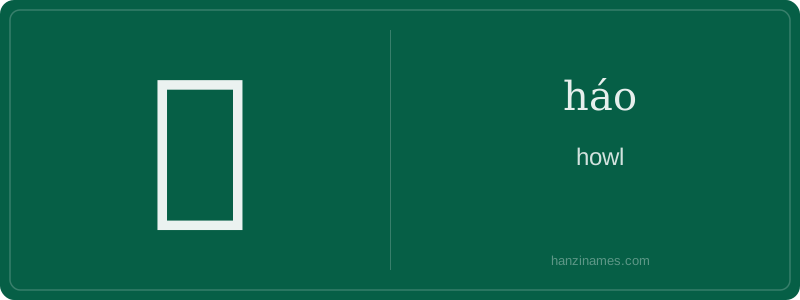
In modern Mandarin, 嚎 is used primarily in literary, dramatic, or expressive contexts—not daily small talk. It appears in idioms like 嚎啕大哭 (háotáo dàkū), meaning 'to weep uncontrollably', widely taught in textbooks and used in news reports describing public grief. It also features in ecological writing about wolves or hyenas, and occasionally in internet slang for exaggerated emotional reactions (e.g., '我快嚎出来了'—'I’m about to howl [from stress]').
The character is not pictographic—no ancient form depicts a howling animal. Its structure is phono-semantic: 口 (mouth/sound) + 豪 (háo, both phonetic and reinforcing intensity). The earliest confirmed usage is in the Han dynasty text *Shuoyuan*, describing mourners’ cries. Today, Chinese learners encounter it most often through the fixed phrase 嚎啕大哭 in HSK 5-level reading passages.
Our detective begins at the crime scene: the character 嚎 (háo), meaning 'to howl'. At first glance, it’s a mouth radical (口) paired with a complex right-hand component. But this isn’t just noise—it’s vocal intensity captured in ink. The 口 radical signals speech or sound production, anchoring the character firmly in the domain of vocal expression. Every stroke contributes to its visceral weight—this is no gentle murmur, but a full-throated, emotionally charged cry.
The right side, 豪 (háo), is not merely phonetic decoration—it carries semantic gravity. Originally meaning 'grand', 'bold', or 'unrestrained', 豪 implies excess, power, and lack of inhibition. Combined with 口, it forms a compound ideograph where sound meets force: a howl is not just acoustic output—it’s raw, unfiltered emotional release. This dual-layer construction reflects classical Chinese word formation: form + function, sound + spirit.
Historically, 嚎 appears relatively late in standard texts—rare in pre-Qin oracle bones or bronze inscriptions, but well-attested in Han dynasty poetry and Tang-Song narrative prose. Its emergence aligns with increased literary focus on animal behavior and human emotional extremes. Unlike older onomatopoeic characters like 吠 (bark) or 啼 (cry), 嚎 conveys duration, volume, and wildness—think wolves at midnight or grief-stricken lamentation. Its 17 strokes aren’t arbitrary; they map the physical effort behind the act: jaw drop, chest expansion, sustained exhalation.
Example Sentences
Common Compounds
Similar Characters — Don't Mix These Up
Your First Step into Chinese Culture: Get a Chinese Name
Every journey into Chinese begins with a name. Use our free Chinese name generator to create a meaningful, personalized Chinese name that fits you perfectly.
Get My Chinese Name →