嚓
Character Story & Explanation
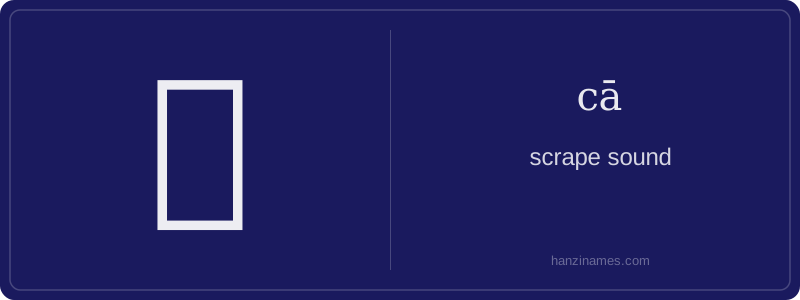
In contemporary Chinese, 嚓 is almost exclusively used as an onomatopoeic syllable in reduplicated forms (e.g., 嚓嚓) or compound expressions (e.g., 嚓啦, 嚓嚓响). It appears in modern literature, subtitles, and spoken narratives to depict scraping, grating, or sudden sharp sounds—especially in action scenes or children’s media. While absent from classical texts, its usage surged in 20th-century vernacular fiction and is well-documented in the Contemporary Chinese Dictionary (7th ed., 2016) as a sound-word (拟声词).
The character is not pictographic or ideographic in origin; it’s a phono-semantic compound: 口 (mouth/sound) + 察 (cā, originally meaning 'to observe', here serving phonetically). Its form evolved during the regular script (kǎishū) period—no oracle bone or bronze inscription evidence exists. Today, Chinese learners encounter it most often in audio-visual contexts, like watching a street vendor sharpen tools or hearing cartoon sound effects.
Imagine walking through Beijing’s hutongs on a crisp winter morning. An elderly vendor sharpens his cleaver on a whetstone beside his dumpling stall—cā… cā… cā—a sharp, rhythmic scraping sound that cuts through the quiet air. This is the very essence of 嚓 (cā): an onomatopoeic character capturing the gritty, metallic scrape of metal on stone or wood. Its mouth radical (口) signals it’s a vocalized sound, not a visual or abstract concept.
Unlike descriptive adjectives, 嚓 doesn’t mean ‘sharp’ or ‘loud’—it *is* the sound itself. In Mandarin, such characters are indispensable for vivid storytelling: writers use them to anchor readers in sensory reality. Think of a knife slicing frozen dough, a chair dragged across a tile floor, or a match striking flint—all evoke 嚓 when rendered authentically in text or speech.
Though rarely used alone in formal writing, 嚓 thrives in spoken Mandarin and creative language. It appears frequently in children’s books, comic dialogues (manhua), and film subtitles to convey immediacy and texture. Its alternate pronunciation chā occurs in dialectal or emphatic contexts—like a louder, more abrupt scrape—but cā remains standard in Putonghua and dictionaries like the Xiàndài Hànyǔ Cídiǎn.
Example Sentences
Common Compounds
Similar Characters — Don't Mix These Up
Your First Step into Chinese Culture: Get a Chinese Name
Every journey into Chinese begins with a name. Use our free Chinese name generator to create a meaningful, personalized Chinese name that fits you perfectly.
Get My Chinese Name →