啮
Character Story & Explanation
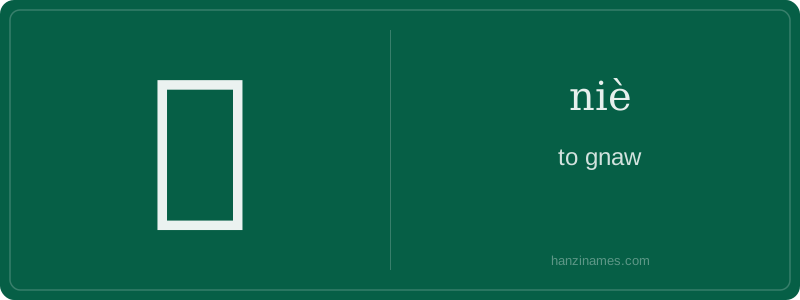
In contemporary Chinese, 啮 appears most frequently in technical, literary, or ecological contexts—not daily conversation. It’s standard in scientific terminology (e.g., 啮齿动物 'rodent'), environmental reports ('rats gnawing through wiring'), and classical-style prose. A well-documented idiom is 啮臂为盟 (niè bì wéi méng)—'bite the arm to swear an oath'—recorded in the Shuoyuan (c. 15 BCE), where loyal ministers bit their arms to seal loyalty, symbolizing irreversible commitment through self-inflicted pain.
The character evolved from seal script (c. 3rd c. BCE), where the right side clearly depicted two rows of teeth (齒) gripping a bone or stick. By the Han dynasty, it standardized into 齧 (with 齒 + 氺-like element), later simplified to 啮 in 1956. Its core visual logic remains intact: mouth (口) + biting action—no abstraction, only biomechanics rendered in ink.
As an archaeologist brushing dust from a Han dynasty bamboo slip, I find 啮 inscribed in clerical script—its 口 radical not merely a 'mouth' but a dynamic aperture: jaws in motion. The right side, 齧 (simplified to 啮), preserves ancient bone inscriptions where interlocking teeth were drawn with stark, angular strokes—evidence that this character was never passive speech, but visceral, rhythmic chewing.
This is no gentle bite. 啮 conveys persistent, abrasive action—rodents gnawing wood, time eroding stone, or resentment corroding the heart. In excavated medical texts like the Mawangdui Silk Manuscripts, 啮 appears in descriptions of parasitic worms 'gnawing at the intestines', revealing its early association with invasive, cumulative damage—not sudden violence, but slow, insistent consumption.
Even today, the character retains its primal texture. When modern linguists analyze its phonetic component (齧 → niè), they trace it to Old Chinese *ŋrəp—echoing the guttural, grinding sound of mastication. Thus, 啮 is a fossilized onomatopoeia: not just what is done, but how it *sounds*—a rasping, repetitive friction captured in eleven deliberate strokes.
Example Sentences
Common Compounds
Similar Characters — Don't Mix These Up
Your First Step into Chinese Culture: Get a Chinese Name
Every journey into Chinese begins with a name. Use our free Chinese name generator to create a meaningful, personalized Chinese name that fits you perfectly.
Get My Chinese Name →