呖
Character Story & Explanation
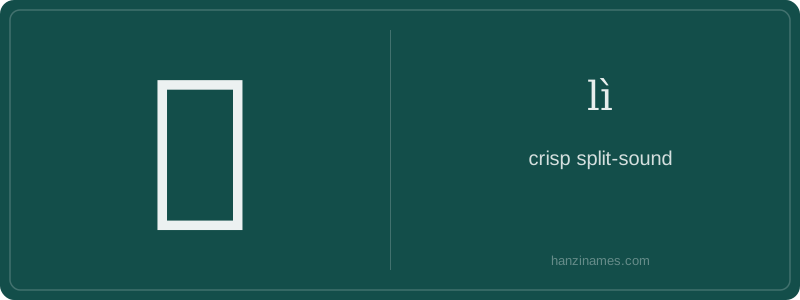
呖 is rarely used independently in modern Mandarin and does not appear in any HSK vocabulary list (HSK Level: Not included). It occurs almost exclusively within fixed compounds like 呖呖 (lì lì), an叠词 (reduplicated form) describing clear, crisp, high-pitched bird calls—especially in classical poetry and ornithological descriptions. The phrase '呖呖莺声' (lì lì yīng shēng) appears in Tang and Song dynasty texts to evoke springtime and lyrical refinement. Today, it survives mainly in literary or stylistic contexts, such as nature documentaries narrated in formal Mandarin or calligraphy inscriptions.
The character’s form is not pictographic: its 口 (mouth) radical signals vocalization, while the right side ‘历’ is a standardized phonetic component borrowed for sound, not meaning. No oracle bone or bronze script forms of 呖 are attested—the earliest verified usage appears in Ming-Qing vernacular literature and rhyme dictionaries like the 《康熙字典》 (Kangxi Dictionary, 1716), where it is defined precisely as 'the sound of splitting' and cross-referenced with bird-call usage.
The character 呖 (lì) is a phonetic-ideographic compound belonging to the 口 (mouth/speech) radical family, indicating it relates to vocalized or onomatopoeic sounds. With just seven strokes, it’s visually compact yet expressive—its right-hand component ‘历’ (lì, originally meaning 'to experience' or 'calendar') serves primarily as a phonetic cue rather than a semantic one. Unlike many common Chinese characters, 呼, 啊, or 哎, which denote everyday speech or emotion, 呖 carries a highly specific auditory nuance: the sharp, crisp, almost brittle sound of something splitting or tearing.
This character evokes precision in sound description—not ambient noise, but a momentary acoustic event with tactile qualities: think of bamboo snapping, parchment ripping, or ice fracturing under pressure. In classical and modern literary usage, it appears sparingly but deliberately, often in poetic or descriptive prose to heighten sensory realism. Its rarity makes it distinctive; learners won’t encounter it in beginner dialogues, but may spot it in nature writing, martial arts fiction, or sound-effect-laden comic strips (manhua).
Western equivalents are scarce because English lacks dedicated single-character onomatopoeias for 'splitting sound'. We say 'crack', 'snap', 'pop', or 'riiiip', each tied to context (e.g., 'crack' for bone or whip; 'rip' for fabric). 呖 transcends medium—it can describe wood, silk, voice strain, or even metaphysical rupture—making it more abstract and versatile than English analogues. This reflects a broader Chinese linguistic tendency: using monosyllabic, radical-rooted characters to encode sensorially rich, context-agnostic sonic essences.
Example Sentences
Common Compounds
Similar Characters — Don't Mix These Up
Your First Step into Chinese Culture: Get a Chinese Name
Every journey into Chinese begins with a name. Use our free Chinese name generator to create a meaningful, personalized Chinese name that fits you perfectly.
Get My Chinese Name →