嚭
Character Story & Explanation
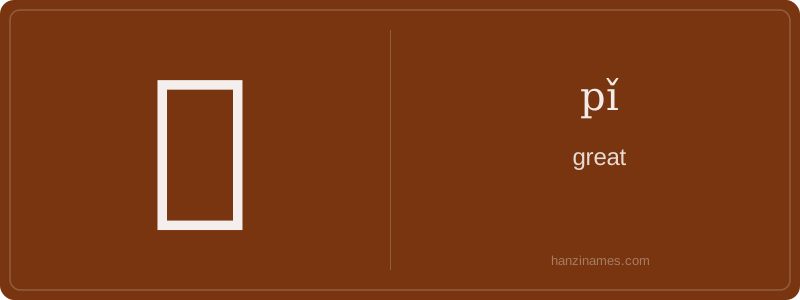
嚭 is virtually unused in contemporary Chinese life. It appears only in historical texts as part of the proper name 伯嚭 (Bó Pǐ), a notorious 6th-century BCE Wu state minister criticized in the Zuo Zhuan and Records of the Grand Historian for corruption and betrayal. No modern idiom, phrase, or compound contains 嚭 outside scholarly references to this figure.
The character is not a pictograph or ideograph with clear ancient origins—it is a late-form phonosemantic compound (形声字), likely created during the Warring States period to transcribe the name 'Pǐ'. Its structure (口 + 比 + 丕) suggests oral articulation (口) combined with phonetic components, but it was never standardized for general semantic use—unlike common characters such as 大 (dà, 'big') or 伟 (wěi, 'great').
The character 嚭 (pǐ) is exceptionally rare in modern Chinese—so rare that it does not appear in the standard GB2312 or Unicode Basic Multilingual Plane as a commonly used character. It is absent from all HSK vocabulary lists, mainstream dictionaries (e.g., Xiàndài Hànyǔ Cídiǎn), and contemporary corpora. Its near-total disappearance reflects how Chinese language evolution prunes archaic forms, preserving only those with functional or cultural resonance.
This rarity itself offers insight into the Chinese worldview: language is deeply pragmatic and historically layered. Characters survive not by inherent elegance but by utility—through inclusion in classics, idioms, names, or administrative use. 嚭 fails this test; it carries no semantic weight in modern discourse, revealing how Chinese linguistic ecology favors continuity through usage—not antiquity.
Its absence invites reflection on cultural memory: unlike Latin’s preserved but unused forms, Chinese rarely retains ‘dead’ characters without at least mythological or onomastic foothold. 嚭 has neither. Thus, it stands as a quiet testament to the language’s ruthless efficiency—where meaning must earn its place daily, or vanish entirely. This mirrors broader Confucian values: worth is demonstrated in action, not claimed by origin.
Example Sentences
Common Compounds
Similar Characters — Don't Mix These Up
Your First Step into Chinese Culture: Get a Chinese Name
Every journey into Chinese begins with a name. Use our free Chinese name generator to create a meaningful, personalized Chinese name that fits you perfectly.
Get My Chinese Name →