嚯
Character Story & Explanation
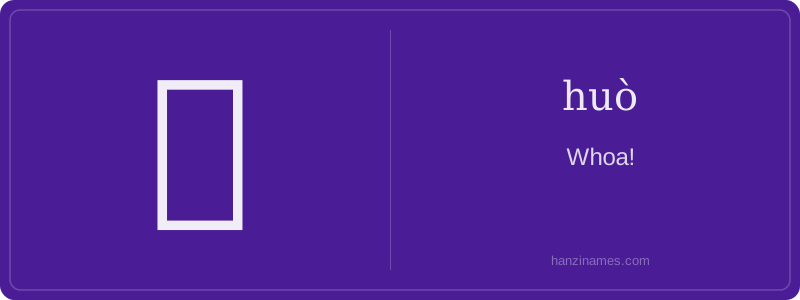
嚯 is overwhelmingly used in modern Mandarin as a spontaneous interjection expressing awe, disbelief, or impressed surprise—especially in spoken language, internet forums, and livestream commentary. It frequently opens reactions: '嚯!这操作太秀了!' ('Whoa! That move is next-level!'). While absent from formal writing and most HSK vocabulary lists (it’s not assigned an official HSK level), it appears in contemporary media, subtitles, and social media comments—often doubled (嚯嚯) for heightened effect. Linguists note its rise correlates with digital speech patterns emphasizing immediacy and emotional authenticity.
The character has no ancient pictographic origin—it’s a relatively late phonosemantic compound. Its right component 霍 (huò) was borrowed solely for pronunciation; historically, 霍 meant 'to scatter suddenly' (like birds flying off), possibly reinforcing the sense of abrupt, visceral reaction. But 嚯 itself emerged as a dedicated mouth-signaling variant—no oracle bone or seal script precursors exist.
As a linguistic detective, I begin at the scene: the character 嚯 (huò) appears late in Chinese orthographic history—absent from oracle bones and bronze inscriptions, and rare even in classical texts. Its first documented appearances surface in Ming and Qing dynasty vernacular novels and folk storytelling scripts, where it functions not as a lexical word but as a phonetic exclamation—akin to English 'whoa!' or 'wow!' Written with the mouth radical 口, it signals vocalization, not semantics; the right side (霍) is purely phonetic, borrowed for its sound, not meaning.
The radical 口 anchors it firmly in spoken expression—this isn’t a concept you read silently; it’s something you *emit*. The 19 strokes include intricate repetitions (three '冖'-like covers and stacked '隹' components in 霍), reflecting its role as a stylized, emphatic burst—not a casual utterance, but one sharpened by performance context. Its complexity suggests deliberate design for theatrical or oral emphasis, not everyday writing efficiency.
Unlike semantic characters that evolve meaning over centuries, 嚯 remains stubbornly onomatopoeic and pragmatic. It doesn’t denote admiration *as a state*, but *marks the instant* of surprise—a verbal exclamation point. Modern dictionaries classify it as an interjection (叹词), not a verb or noun. Its stability across centuries underscores how deeply embedded vocal exclamations are in Chinese expressive grammar—even when untranslatable, they persist as cultural punctuation.
Example Sentences
Common Compounds
Similar Characters — Don't Mix These Up
Your First Step into Chinese Culture: Get a Chinese Name
Every journey into Chinese begins with a name. Use our free Chinese name generator to create a meaningful, personalized Chinese name that fits you perfectly.
Get My Chinese Name →