亸
Character Story & Explanation
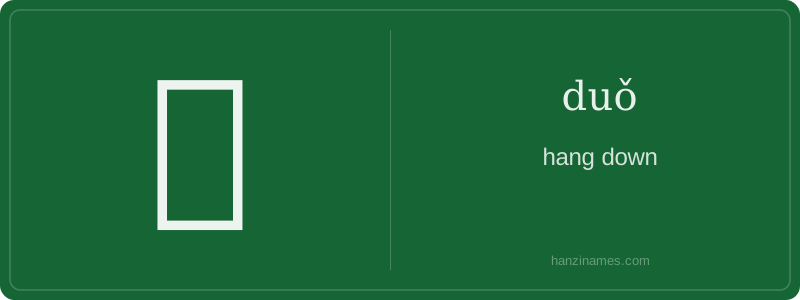
亸 is a rare, literary character with virtually no use in modern spoken Mandarin or daily writing. It appears almost exclusively in classical poetry, Song lyrics (ci), and ornate descriptive prose—especially to depict delicate, downward physical states: drooping sleeves, sagging curtains, or wilting flowers. You’ll find it in anthologies like the Complete Tang Poems (《全唐诗》) and Ming-Qing fiction such as Plum in the Golden Vase (《金瓶梅》), always in highly stylized, aesthetic contexts.
The character is a variant form of 朵 (duǒ, 'flower/bud'), sharing the same phonetic component (多) and radical (亠). Its distinct shape adds the 'person' radical (亻) to emphasize human posture—suggesting a person’s head or sleeve hanging down. Though not pictographic in origin, its structure visually conveys slumping posture, aligning with documented usage in Ming-era texts describing melancholy or languid elegance.
The character 亸 (duǒ) embodies a quiet, almost poetic acknowledgment of gravity—not just physical, but emotional and aesthetic. In Chinese worldview, 'hanging down' is never merely passive; it suggests graceful surrender, ripeness ready to fall, or weary elegance—like willow branches bending under spring rain or silk sleeves trailing in a Tang dynasty dance. This gentle downward motion reflects Daoist reverence for natural flow and the Confucian value of modesty: true strength often manifests as softness, yielding without breaking.
Unlike Western binaries of 'up=good, down=bad', 亸 carries no inherent negativity. Its downward orientation evokes humility, receptivity, and cyclical renewal—think of autumn leaves descending to nourish roots. In classical poetry, 亸 describes drooping blossoms not as decay, but as fulfillment: a peach branch heavy with fruit, a curtain swaying in breeze, or sorrow so deep it weighs the eyelids. This nuance reveals how Chinese semantics embed cosmology in morphology.
Visually sparse yet semantically rich, 亸 invites contemplation of liminality—the suspended moment before release. It appears in contexts where tension meets relaxation: a sigh escaping lips, ink bleeding slightly on rice paper, or hair loosening from a bun. Such micro-movements are culturally significant: they signal authenticity, vulnerability, and harmony with natural law (天道, tiāndào). To recognize 亸 is to perceive beauty in gentle descent—a subtle reminder that in Chinese thought, falling can be an act of grace, not failure.
Example Sentences
Common Compounds
Similar Characters — Don't Mix These Up
Your First Step into Chinese Culture: Get a Chinese Name
Every journey into Chinese begins with a name. Use our free Chinese name generator to create a meaningful, personalized Chinese name that fits you perfectly.
Get My Chinese Name →