嚣
Character Story & Explanation
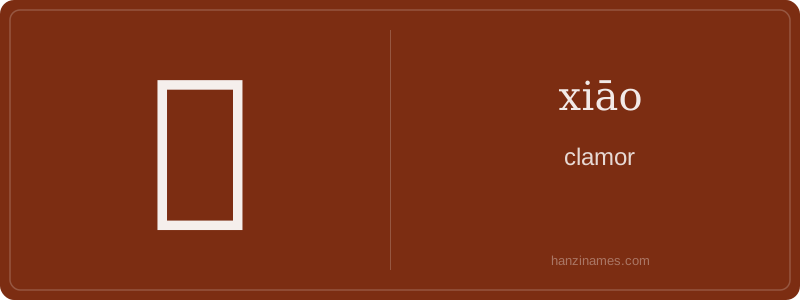
嚣 is rarely used alone in modern spoken Chinese but appears in fixed literary and journalistic compounds like 嚣张 (xiāozhāng, 'arrogant and aggressive') — frequently seen in news headlines criticizing corruption or bullying behavior. It also appears in classical idioms such as 嚣然自得 (xiāorán zìdé, 'smugly self-satisfied'), documented in Ming-Qing dynasty prose. Government media use 嚣张 to condemn official misconduct, making it politically resonant.
The character’s form is not pictographic but phono-semantic: the four 口 radicals emphasize vocal multiplicity, while the phonetic component 吕 (lǚ) hints at pronunciation. Though its earliest attestation is in bronze inscriptions (c. 1000 BCE), scholars agree its structure evolved to convey amplified, unrestrained vocalization — not a literal depiction of mouths, but a conceptual intensifier.
Imagine standing in Beijing’s Wangfujing pedestrian street at noon — vendors shout, delivery e-scooters beep, tourists chatter in ten languages, and a street performer drums wildly. This overwhelming sensory surge is precisely what 嚣 (xiāo) captures: not just noise, but layered, chaotic, human-generated clamor — urgent, collective, and slightly unruly.
The character’s structure reflects this intensity: four 口 (mouths) surround a central 吕 (a variant of 口, meaning ‘a pair of mouths’), suggesting multiplied voices echoing in all directions. It’s not random sound like 音 (sound) or 声 (voice), but deliberate, often disruptive vocal energy — think protest chants, market haggling, or a rowdy banquet.
Historically, 嚣 appears in classical texts like the *Zuo Zhuan* to describe battlefield din or political tumult. In modern usage, it carries a subtle negative connotation — implying excessive, unwarranted, or arrogant noise. Its rarity in daily speech (unlike common words like 声 or 噪) makes it literary and emphatic, reserved for vivid description or formal critique.
Example Sentences
Common Compounds
Similar Characters — Don't Mix These Up
Your First Step into Chinese Culture: Get a Chinese Name
Every journey into Chinese begins with a name. Use our free Chinese name generator to create a meaningful, personalized Chinese name that fits you perfectly.
Get My Chinese Name →