囊
Character Story & Explanation
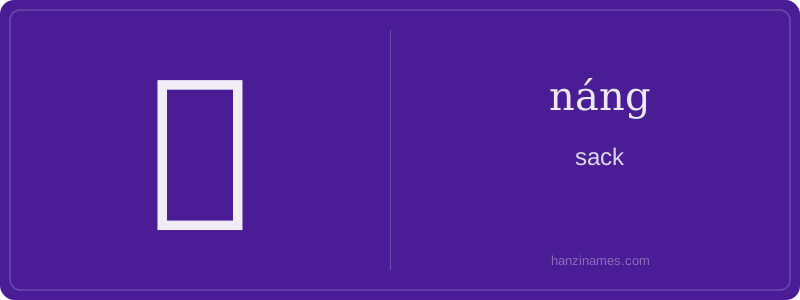
Historically, 囊 referred to cloth or leather sacks used across imperial China for storing grain, tax payments, examination scrolls, and medicinal herbs. In daily life today, it appears in formal and literary contexts: in idioms like 锦囊妙计 (jǐn náng miào jì — 'a brilliant strategy stored in a brocade sack'), referencing Zhuge Liang’s legendary tactical pouches, and in compound words like 钱囊 (qián náng — 'purse' or 'wallet'). It’s rarely used alone in speech but thrives in set phrases and bureaucratic or literary writing.
The character’s form has no verified oracle-bone origin. Its earliest attested shape is in Qin bamboo slips and Han dynasty clerical script, clearly depicting a tied-mouth sack — the top 口 = opening, the lower part = body with gathered base. Modern users encounter it most often in exams (HSK 6), classical texts, or financial terms like 腰囊 (yāo náng — 'waist pouch', metaphor for personal funds).
As a detective tracing 囊’s evolution, I begin at the Han dynasty — not earlier. Oracle bone or bronze inscriptions show no clear precursor; the earliest secure forms appear in clerical script (lìshū), where it already resembles a pouch with a tied mouth: the top 口 suggests an opening, while the complex lower component (now written as 一冂丨丿丶丶丶丶) historically represented folds and drawstrings of a cloth sack. This wasn’t abstracted from nature but engineered from function.
Zooming in on structure: though classified under radical 口 (‘mouth’), 囊 isn’t about speech — 口 here denotes an *opening*, like a bag’s mouth. The 22 strokes meticulously encode containment: horizontal lines for folded fabric, verticals for seams, and eight dots (the final four 丶丶丶丶) stylized as gathered threads or tassels. It’s a rare case where stroke count reflects physical complexity — each stroke maps to a tangible feature of traditional Chinese sacks.
This character resisted simplification in mainland China (unlike many others), preserving its full 22-stroke form even in modern standard usage — a testament to its semantic stability. Its consistency across 2,000 years signals how deeply embedded the concept of the ‘bound sack’ was in material culture: for grain, documents, medicine, or even poetic metaphors for hidden talent. No radical overhaul was needed because the object — and its symbolic weight — never vanished.
Example Sentences
Common Compounds
Similar Characters — Don't Mix These Up
Your First Step into Chinese Culture: Get a Chinese Name
Every journey into Chinese begins with a name. Use our free Chinese name generator to create a meaningful, personalized Chinese name that fits you perfectly.
Get My Chinese Name →