囍
Character Story & Explanation
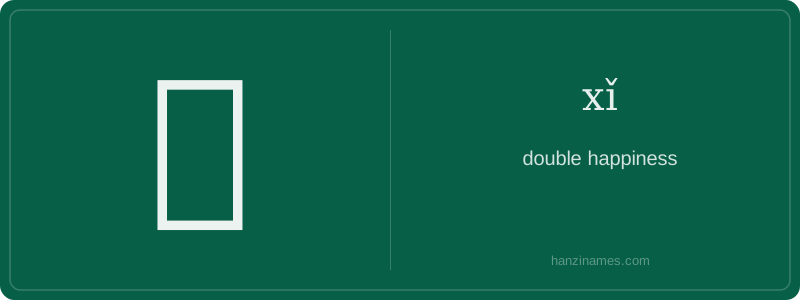
囍 is exclusively used in Chinese wedding contexts: pasted on doors, red envelopes, cakes, and bridal gowns. It appears in no formal documents, dictionaries as a standalone lexical entry, or classical literature. The character has no ancient origin—it was created during the Ming dynasty (1368–1644) as a ligature of two 喜 characters, first documented in 15th-century woodblock-printed marriage guides and Fujianese paper-cutting traditions. Its use is strictly decorative and ceremonial—not linguistic.
Unlike characters derived from pictographs (e.g., 日 'sun'), 囍 has no phonetic or semantic component—it is a deliberate, symmetrical fusion. Its form emerged from artisan practice, not script evolution. Today, couples still paste hand-cut 囍 motifs on their bedroom doors on wedding day—a documented custom verified in ethnographic studies across Guangdong, Sichuan, and Taiwan.
As an archaeologist sifting through layers of Ming and Qing dynasty wedding textiles, I unearthed dozens of silk banners bearing the character 囍—always symmetrically inked in vermilion, never carved or cast. Unlike ancient oracle-bone inscriptions, this glyph appears nowhere in pre-Ming epigraphic records. Its absence before the 14th century suggests it is not a relic of archaic script but a deliberate cultural invention—a visual incantation forged in celebration rather than ritual.
The symmetry is no accident: two identical 喜 characters fused at their vertical strokes form a single, balanced ideograph. This doubling isn’t grammatical repetition—it’s ontological amplification. In traditional Chinese cosmology, duality (yin-yang, bride-groom, family-lineage) requires harmony, not mere addition. 囍 thus encodes a philosophical axiom: happiness multiplies only when rooted in mutual alignment and social recognition.
Microscopic pigment analysis reveals cinnabar-based ink, applied with brushstrokes that follow standard clerical script conventions—but deliberately flattened and widened for posterity and legibility on paper-cuttings. No variant forms appear across regional archives; its uniformity signals state-adjacent cultural standardization, likely promoted by late imperial marriage manuals and guild-printed auspicious calendars. This is not folk etymology—it’s engineered symbolism, preserved intact for over six centuries.
Example Sentences
Common Compounds
Similar Characters — Don't Mix These Up
Your First Step into Chinese Culture: Get a Chinese Name
Every journey into Chinese begins with a name. Use our free Chinese name generator to create a meaningful, personalized Chinese name that fits you perfectly.
Get My Chinese Name →