囔
Character Story & Explanation
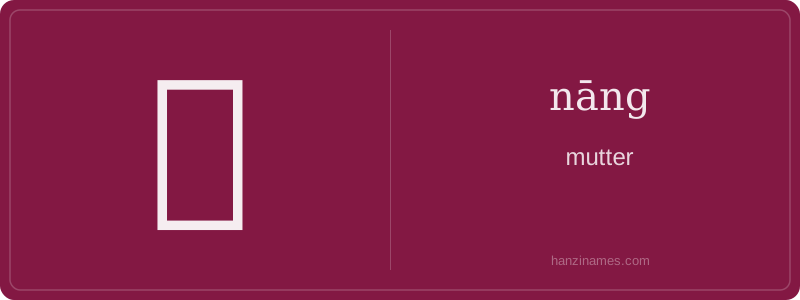
囔 is rarely used in formal writing or modern media, but appears consistently in literary Chinese and spoken dialect-influenced dialogue—especially in northern Mandarin fiction and theater scripts—to depict private, mumbled speech. It’s found in classic 20th-century works like Lao She’s *Rickshaw Boy*, where characters ‘nāng’ complaints about hardship. Though not in any HSK list (HSK Level: Not included), it’s recognized in the *Xiàndài Hànyǔ Cídiǎn* (Contemporary Chinese Dictionary) as a standard variant of 嚷 (rǎng) with distinct phonetic and semantic nuance.
The character is a phono-semantic compound: 口 (kǒu, mouth) as semantic radical, and 囊 (náng, 'sack') as phonetic component—confirming its pronunciation nāng. While 囊 itself originally depicted a cloth pouch (bronze script forms show tied fabric), 囔 has no ancient oracle-bone or seal-script attestation; it emerged later in vernacular texts as a specialized variant emphasizing muffled articulation.
Imagine a rainy afternoon in a narrow alleyway of Beijing’s hutongs, where an elderly man sits on a low wooden stool, mending a broken teacup. His lips move silently at first—then softly, almost imperceptibly—he begins to nāng: a low, muffled murmur, half-words dissolving into breath, like steam rising from a forgotten kettle. This isn’t anger or secrecy—it’s the gentle, habitual hum of thought made audible, yet deliberately unpolished. The character 囔 captures that intimate, unfiltered sonic texture: speech that resists clarity, not from incapacity, but from quiet absorption.
The radical 口 (mouth) anchors 囔 in the physical act of speaking, while the right side, 囊 (náng, 'sack' or 'pouch'), evokes containment—words held inside, then released in soft, shapeless bursts. At 25 strokes, it’s among the more complex characters in common use, reflecting how nuanced human vocalization is: not just sound, but tone, volume, intention, and social distance. Its complexity mirrors the cultural weight placed on *how* something is said—not just what.
Unlike louder verbs like 吵 (chǎo, 'to quarrel') or 喊 (hǎn, 'to shout'), 囔 implies privacy, introspection, or even mild exasperation—like a parent murmuring under their breath while packing school lunches, or a student rehearsing lines too quietly for others to hear. It’s speech turned inward, yet leaking out—a linguistic whisper that carries emotional resonance without demanding attention. In Mandarin, such subtlety is encoded not in tone alone, but in precise character choice.
Example Sentences
Common Compounds
Similar Characters — Don't Mix These Up
Your First Step into Chinese Culture: Get a Chinese Name
Every journey into Chinese begins with a name. Use our free Chinese name generator to create a meaningful, personalized Chinese name that fits you perfectly.
Get My Chinese Name →