囚
Character Story & Explanation
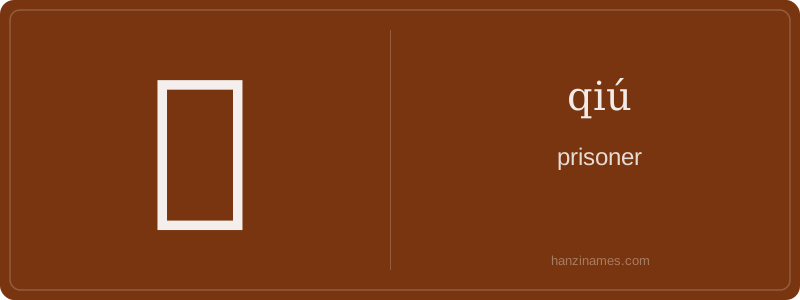
In contemporary China, 囚 appears most frequently in formal writing: court documents (e.g., ‘在押囚犯’ — detained prisoner), news reports about criminal cases, and historical documentaries. A well-known idiom is 囚首垢面 (qiú shǒu gòu miàn), meaning 'unkempt and disheveled'—originally describing prisoners too neglected to groom themselves. This phrase appears in the Song-dynasty classic *Zizhi Tongjian* and remains in literary use today.
Graphically, 囚 is a clear ideograph: the outer 囗 represents an enclosure or wall, while the inner 人 (person) is simplified to (a stylized human figure). Oracle bone script evidence confirms this structure existed by the Shang dynasty (c. 1600–1046 BCE), making it one of the oldest attested confinement symbols in Chinese writing.
The character 囚 (qiú) visually captures confinement: a person (人) trapped inside an enclosure (囗), symbolizing loss of freedom. Its five-stroke simplicity belies its heavy cultural weight—used since ancient times to denote captives, convicts, or political detainees. In modern Chinese, it appears in legal, historical, and literary contexts, always evoking restriction, punishment, or vulnerability.
Unlike neutral terms like 犯人 (fànrén, 'offender'), 囚 carries archaic gravity and moral resonance. It’s rarely used in casual speech but appears in formal documents, classical poetry, and media reporting on detention—especially when emphasizing dehumanization or injustice. Its radical 囗 ('enclosure') links it to other containment-related characters like 囚禁 (qiújìn, 'to imprison') and 囚徒 (qiútú, 'prisoner').
This character reflects China’s long-standing legal traditions: the earliest known usage appears in bronze inscriptions from the Western Zhou dynasty (c. 1046–771 BCE), where it denoted war captives forced into servitude. Today, 囚 remains embedded in legal terminology and human rights discourse—its stark form reminding readers that language itself can mirror walls, bars, and silence.
Example Sentences
Common Compounds
Similar Characters — Don't Mix These Up
Your First Step into Chinese Culture: Get a Chinese Name
Every journey into Chinese begins with a name. Use our free Chinese name generator to create a meaningful, personalized Chinese name that fits you perfectly.
Get My Chinese Name →