囝
Character Story & Explanation
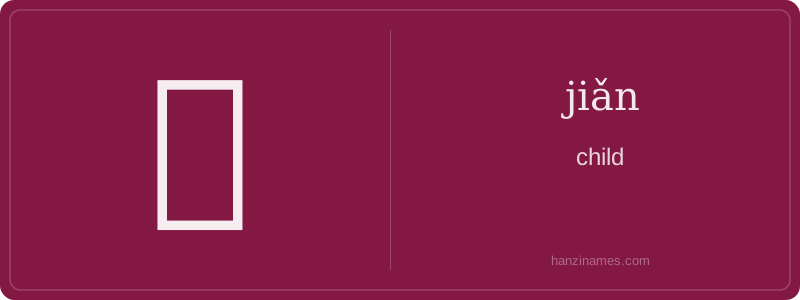
囝 is primarily a Min Nan (Hokkien/Teochew) dialect word for 'child', documented since at least the Tang dynasty in poetry and folk records. It appears in classical Southern texts like the 12th-century Fujian Annals and remains vibrant in modern Taiwanese opera, Min Nan pop songs (e.g., 'A-Gu's Lullaby'), and colloquial speech in Xiamen and Tainan. You’ll rarely see it in mainland Mandarin media, but it’s essential in local education initiatives preserving Southern dialects.
The character is a phono-semantic compound: the outer 囗 (wéi) is the semantic component suggesting 'enclosed space' or 'belonging', while the inner 子 (zǐ) both hints at meaning ('child') and historically influenced its pronunciation. Though not an ancient pictograph, its structure reflects how dialect characters often repurpose standard components for local phonetic needs.
Hi students! Let’s meet 囝 (jiǎn) — a warm, affectionate word for 'child', especially used in southern Chinese dialects like Min Nan (spoken in Fujian and Taiwan). Unlike the standard Mandarin word 孩子 (háizi), 囝 carries deep regional flavor and emotional closeness — think of a grandmother calling her grandson ‘my little 囝’ with a soft smile. It’s not formal or textbook-heavy; it’s spoken, tender, and rooted in everyday family life.
This character is simple: only six strokes, built around the enclosing radical 囗 (wéi), meaning 'enclosure' or 'boundary'. Inside is 子 (zǐ), meaning 'child' — so visually, it’s 'a child enclosed', evoking protection and intimacy. Though rarely seen in formal writing or HSK textbooks, 囝 appears frequently in folk songs, local literature, and oral storytelling across Fujian, Taiwan, and overseas Min-speaking communities.
Don’t confuse 囝 with more common characters like 儿 (ér) or 孩 (hái). Its pronunciation jiǎn is unique — the third tone, like the sound of gently tapping a wooden door. Because it’s dialectal, you won’t hear it on CCTV news, but you *will* hear it in a Hokkien lullaby or a grandmother’s call across a village courtyard. Learning 囝 opens a window into regional identity, linguistic diversity, and the heart of Chinese familial love beyond Mandarin.
Example Sentences
Common Compounds
Similar Characters — Don't Mix These Up
Your First Step into Chinese Culture: Get a Chinese Name
Every journey into Chinese begins with a name. Use our free Chinese name generator to create a meaningful, personalized Chinese name that fits you perfectly.
Get My Chinese Name →