囟
Character Story & Explanation
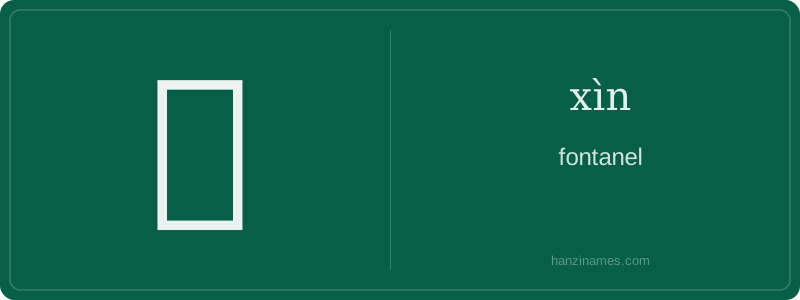
In contemporary China, 囟 appears almost exclusively in clinical settings: pediatricians assess the ‘anterior 囟’ (前囟) during routine 1–2 month checkups; ultrasound technicians document its closure timing (typically 12–18 months); and TCM practitioners observe its tension or depression as diagnostic clues for Qi deficiency or heat patterns. It’s absent from HSK lists and everyday speech—no idioms or slang use it.
The character’s form is not pictographic but logographic: the outer 囗 (enclosure) frames the inner × (cross), representing the diamond-shaped anterior fontanel where frontal, parietal, and occipital bones meet. This structural depiction was standardized in the *Shuōwén Jiězì* (121 CE) and remains unchanged—no oracle bone or bronze script variants survive, confirming its late, technical origin in medical lexicons.
The character 囟 (xìn) is a rare but medically precise term in Chinese, referring specifically to the soft, membranous gaps between an infant’s skull bones—the fontanelles. Though seldom used in daily conversation, it appears frequently in pediatric healthcare contexts, traditional Chinese medicine texts, and medical education. Its six-stroke form encloses an 'x'-shaped element, symbolizing the intersecting sutures of the newborn’s skull.
Unlike common characters, 囟 has no colloquial or idiomatic extensions—it remains strictly technical. You’ll encounter it on hospital intake forms, ultrasound reports, or TCM diagnostic notes assessing infant development. Its radical 囗 (wéi), meaning 'enclosure', reflects how the fontanel is a bounded, vulnerable space on the head—literally a 'roofless opening' in bone structure.
This character exemplifies how Chinese writing preserves anatomical precision across millennia: unchanged in form since at least the Han dynasty, 囟 appears identically in modern medical journals and ancient pulse-diagnosis manuals. Its rarity underscores a cultural value—using minimal, exact characters for life-critical concepts, especially those tied to infancy, health, and vulnerability.
Example Sentences
Common Compounds
Similar Characters — Don't Mix These Up
Your First Step into Chinese Culture: Get a Chinese Name
Every journey into Chinese begins with a name. Use our free Chinese name generator to create a meaningful, personalized Chinese name that fits you perfectly.
Get My Chinese Name →