囡
Character Story & Explanation
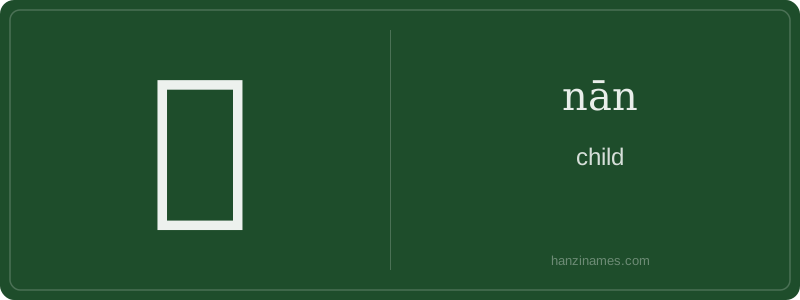
囡 is overwhelmingly used in Wu Chinese dialects (e.g., Shanghainese, Ningbonese) as a tender, diminutive term for 'child' — especially in familial address ('my囡', 'little囡'). It appears in modern literature (e.g., Lu Xun’s brother Zhou Zuoren’s essays) and local media, but is absent from official HSK lists and standardized Mandarin textbooks. You’ll hear it in Shanghai alleyways, Ningbo markets, and family WeChat voice notes — never in formal speeches or news broadcasts.
The character’s form is a clear semantic compound: 囗 (enclosure) + 女 (female/young person). While not an ancient pictograph, its structure reflects Southern Chinese cultural emphasis on familial containment and intimacy — the child ‘held within’ the family circle. No oracle bone or bronze script forms exist; it’s a later vernacular creation, first reliably attested in Ming-era local gazetteers.
Our detective work begins with the outer frame: 囗 (wéi), a radical meaning 'enclosure' — not a literal fence, but a symbolic boundary marking something contained, protected, or defined. Inside sits 女 (nǚ), 'woman' or 'female'. At first glance, this looks like 'a woman enclosed' — but historically, it’s not about confinement. Rather, the enclosure represents care, nurture, and social belonging: a child as a cherished, integrated member of the family unit.
This character emerged in regional Chinese vernacular, not classical texts — its earliest documented appearances are in Song- and Ming-dynasty local records and Wu dialect literature. Unlike standard Mandarin characters shaped by imperial dictionaries, 囡 grew organically from spoken language, especially in Jiangnan (Shanghai, Suzhou, Ningbo). Its simplicity — just six strokes — reflects its function as an affectionate, colloquial term, not a formal lexical item.
Crucially, 囡 is gender-neutral in usage despite containing 女. It refers to any young child, often with tenderness or familiarity — like calling a toddler 'sweetie' rather than 'daughter'. Its phonetic value nān is unrelated to 女 (nǚ); instead, it’s a dialectal reading preserved through oral tradition. This makes 囡 a linguistic fossil: a living, breathing character that resists standardization yet thrives in everyday speech across millions of homes.
Example Sentences
Common Compounds
Similar Characters — Don't Mix These Up
Your First Step into Chinese Culture: Get a Chinese Name
Every journey into Chinese begins with a name. Use our free Chinese name generator to create a meaningful, personalized Chinese name that fits you perfectly.
Get My Chinese Name →