囤
Character Story & Explanation
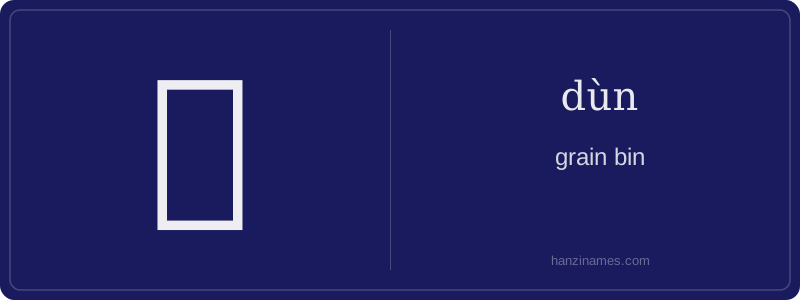
In modern Chinese, 囤 is most commonly used as a verb meaning 'to hoard'—especially food, medicine, or real estate—reflecting enduring cultural anxiety about scarcity. It appears in official media reports (e.g., '囤积居奇' — hoarding goods to manipulate prices, a regulated offense since the 1950s) and everyday speech ('囤货' — stockpiling, widely documented during pandemic lockdowns). Historically, it denoted physical grain bins, as confirmed by Tang legal codes mandating local governments maintain '义仓' (charity granaries) with marked 囤.
The character is not pictographic in oracle bone script (no attested early form), but its seal script (c. 3rd c. BCE) clearly shows 囗 (enclosure) + 屯 (a phonetic component derived from a seedling pushing through soil). Its structure reflects functional semantics: enclosure for preservation—not decoration, but defense against rot, rats, and unrest.
As an archaeologist brushing dust from a Han dynasty granary seal, I find 囤 etched into clay storage tags—its enclosing 囗 radical not merely a 'frame', but a symbolic wall, demarcating sacred, controlled space for grain. The inner '屯' (tún) component, originally a pictograph of sprouting seeds under constraint, evolved into a phonetic-semantic compound: containment + stored life-force. This was no ordinary container—it was economic sovereignty made visible.
Excavations at Juyan and Dunhuang reveal 囤 stamped on bamboo slips recording imperial grain reserves—20,000 shi stored per compound. Its pronunciation dùn reflects the low, heavy tone of a full bin being sealed; tún survives only in dialectal or poetic usage, like 'tún liáng' (to hoard grain), echoing pre-Qin agrarian law texts mandating state-controlled囤储. The character embodies China’s millennia-old obsession with food security as statecraft.
Unlike decorative characters, 囤 bears the grit of utility: its seven strokes are optimized for rapid carving on wood or clay—no flourishes, only function. Even today, when Chinese farmers sketch grain silos on paper, they instinctively begin with the enclosing square—proof that form follows famine-prevention. This is archaeology not of kings, but of calories: how civilization stores tomorrow inside today’s walls.
Example Sentences
Common Compounds
Similar Characters — Don't Mix These Up
Your First Step into Chinese Culture: Get a Chinese Name
Every journey into Chinese begins with a name. Use our free Chinese name generator to create a meaningful, personalized Chinese name that fits you perfectly.
Get My Chinese Name →