囥
Character Story & Explanation
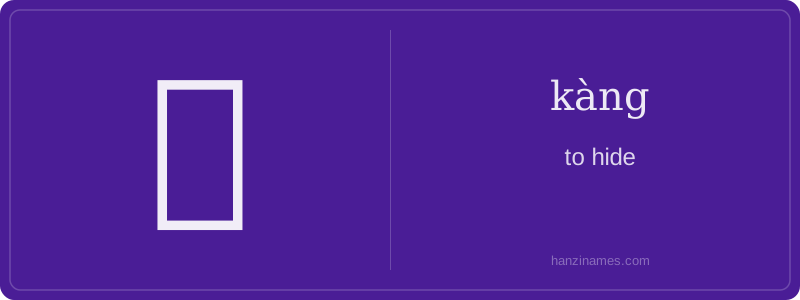
囥 is not used in Standard Mandarin and does not appear in the HSK curriculum, dictionaries like the Xinhua Zidian, or official education materials. It survives almost exclusively in spoken Southern Min dialects—documented in linguistic surveys (e.g., the Dictionary of Southern Min, 2005) and Taiwanese language textbooks. In Taiwan and Fujian, elders use it in phrases like '囥起來' (kàng--khì--lâi, 'hide it away') when instructing children to secure belongings. No standardized idiom features it, and it's absent from classical texts.
The character 囥 is a phono-semantic compound: the outer frame '囗' (wéi, 'enclosure') signals containment; the inner component '亢' (kàng, originally meaning 'high' or 'protruding') serves phonetically. Though its earliest attestation is unclear, its structure reflects a clear semantic logic—'to place something inside an enclosed space'. Today, it appears in Taiwanese-language signage, folk songs, and subtitles for Min Nan dialogue in local dramas.
The Chinese character 囥 (kàng) is a rare, dialectal verb meaning 'to hide' or 'to stash away', primarily preserved in Min Nan (e.g., Hokkien and Taiwanese) and some Wu dialects. Unlike standard Mandarin verbs like cáng (藏) or yǐn (隐), 囥 carries a colloquial, often domestic or playful connotation—like hiding a snack from siblings or tucking away valuables in a drawer. Its usage reflects localized linguistic resilience rather than formal written tradition.
In Western cultural equivalents, 囥 aligns closely with English verbs like 'stash', 'tuck away', or 'squirrel away'—all implying informal, intentional concealment for personal use or safety. Unlike the morally neutral 'hide', these terms often evoke warmth, secrecy, or resourcefulness (e.g., 'stashing cookies'). Similarly, German 'verstecken' is broad, but 'wegstecken' mirrors 囥’s casual, physical nuance—slipping something out of sight quickly and discreetly.
While English has rich idioms for concealment ('under wraps', 'under the radar'), 囥 lacks such figurative extensions in modern usage—it remains grounded in tangible, everyday acts: hiding keys, burying treasure maps as kids, or secreting money in a rice jar. This contrasts with Mandarin’s more abstract or literary synonyms (e.g., yǐncáng 隐藏, used for secrets or data encryption). 囥 thus offers a linguistically intimate window into regional Chinese domestic life—where hiding isn’t ominous, but cozy, practical, and quietly defiant of formality.
Example Sentences
Common Compounds
Similar Characters — Don't Mix These Up
Your First Step into Chinese Culture: Get a Chinese Name
Every journey into Chinese begins with a name. Use our free Chinese name generator to create a meaningful, personalized Chinese name that fits you perfectly.
Get My Chinese Name →