圉
Character Story & Explanation
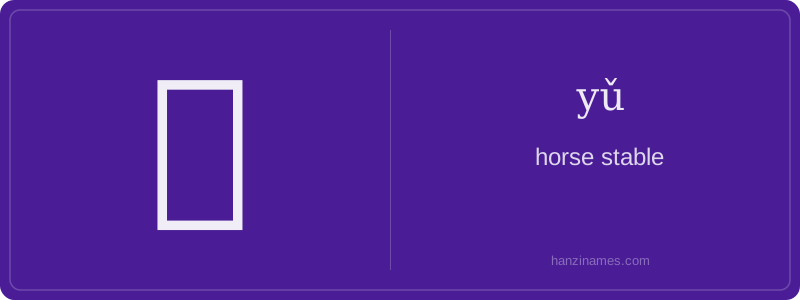
圉 is virtually absent from modern spoken Mandarin and does not appear in the HSK curriculum (HSK 0). It survives almost exclusively in classical Chinese texts, historical records, and literary compounds — e.g., ‘藩圉’ (fān yǔ), meaning 'border defense' or 'frontier bulwark', used in official Tang and Song dynasty documents describing military perimeters. It also appears in the ancient title ‘圉师’ (yǔ shī), a Zhou dynasty official in charge of royal stables and horse breeding.
The character’s form is not pictographic: no archaeological evidence shows it deriving from a drawing of a stable. Instead, it’s a standardized semantic-phonetic compound created during the Warring States period. Today, Chinese learners encounter it only when reading pre-Qin or Han historical texts — not in conversation, apps, or signage.
Our detective work begins at the scene: the character 圉 (yǔ), an 11-stroke glyph sealed within the enclosing radical 囗 — a classic 'enclosure' signifying containment or boundary. This isn’t just any enclosure; it’s a walled compound built for horses — a stable, corral, or paddock. The inner component, 吾, serves phonetically (wú → yǔ via historical sound shift), while its original meaning ('I/we') is irrelevant here — a common case of phonetic loan usage in Chinese script evolution.
Tracing backward, 圉 appears reliably in Warring States bamboo texts and the *Shuōwén Jiězì* (121 CE), where Xu Shen defines it precisely as 'a place to keep horses' (養馬之所). No oracle bone or bronze inscriptions bear this character — it emerged later, during the standardization of bureaucratic terminology for animal husbandry and military logistics. Its design reflects functional literacy: clear semantics (enclosed space) + reliable pronunciation cue (吾).
Unlike pictographic characters like 日 (sun) or 木 (tree), 圉 is abstractly semantic-phonetic (形声字). There’s no surviving visual depiction of a stable — instead, the mind infers containment from 囗 and trusts 吾 to guide pronunciation. This makes 圉 a textbook example of how Chinese writing matured: prioritizing administrative clarity over pictorial fidelity. Its rarity today stems not from obsolescence, but from specialization — it lives on in classical texts, historiography, and compound words, not daily chatter.
Example Sentences
Common Compounds
Similar Characters — Don't Mix These Up
Your First Step into Chinese Culture: Get a Chinese Name
Every journey into Chinese begins with a name. Use our free Chinese name generator to create a meaningful, personalized Chinese name that fits you perfectly.
Get My Chinese Name →