圊
Character Story & Explanation
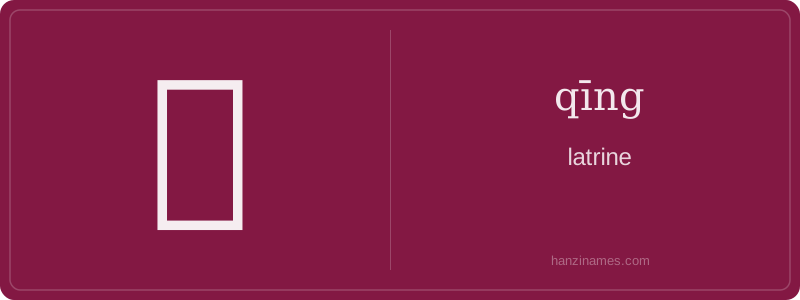
Today, 圊 is virtually absent from spoken Mandarin and rare even in formal writing—replaced by terms like 厕所 (cèsuǒ), 卫生间 (wèishēngjiān), or simply the English loanword 'toilet'. It survives almost exclusively in classical literature, historical inscriptions, and compound words like 圊厕 (qīngcè), found in Ming-Qing dynasty local gazetteers describing public sanitation infrastructure. Modern usage is limited to scholarly contexts, calligraphy demonstrations, or humorous archaism (e.g., a retro-themed café labeling its restroom '古圊').
The character’s origin is not pictographic—it has no oracle bone or bronze script attestation. Instead, it first appears reliably in seal script (c. 3rd century BCE) as a phono-semantic compound: 囗 (enclosure) + 青 (phonetic qīng). Its enduring role is lexical hygiene: a precise, unambiguous term for 'latrine' in pre-modern administrative and medical texts—where clarity outweighed euphony.
Our detective work begins at the scene: the character 圊 (qīng), an 11-stroke glyph enclosed by the 'enclosure' radical 囗. Unlike common radicals tied to meaning (e.g., 氵for water), 囗 here signals containment—not of liquid, but of function: a bounded space designated for bodily elimination. The inner component 青 (qīng, 'blue/green') is phonetic, lending sound but not meaning—yet its presence hints at ancient associations: in early Chinese cosmology, the color blue-green symbolized east and renewal, subtly framing excretion as part of a natural, cyclical process.
Zooming in on historical documents, 圊 appears in Han dynasty bamboo slips and Tang-era medical texts as a formal, almost clinical term—never colloquial. It was reserved for official records, temple inventories, and hygiene ordinances, always paired with words like ‘shed’ (舍) or ‘pit’ (坑). Its rarity in poetry or daily speech suggests it was deliberately kept at arm’s length: polite society named the restroom, but rarely dwelled on it. This linguistic distancing mirrors how many cultures treat sanitation—essential, yet semantically quarantined.
Modern forensic analysis reveals that 圊 has *no* oracle bone or bronze script forms—unlike characters such as 门 (door) or 水 (water), it emerged late, likely during the Warring States or early Han period. Its structure isn’t pictographic but bureaucratic: a phonosemantic compound forged for administrative precision. The radical 囗 doesn’t depict a physical wall—it encloses semantic intent: *this space is defined, regulated, and set apart*. In essence, 圊 is less a picture of a toilet and more a legal boundary marker drawn in ink.
Example Sentences
Common Compounds
Similar Characters — Don't Mix These Up
Your First Step into Chinese Culture: Get a Chinese Name
Every journey into Chinese begins with a name. Use our free Chinese name generator to create a meaningful, personalized Chinese name that fits you perfectly.
Get My Chinese Name →