圌
Character Story & Explanation
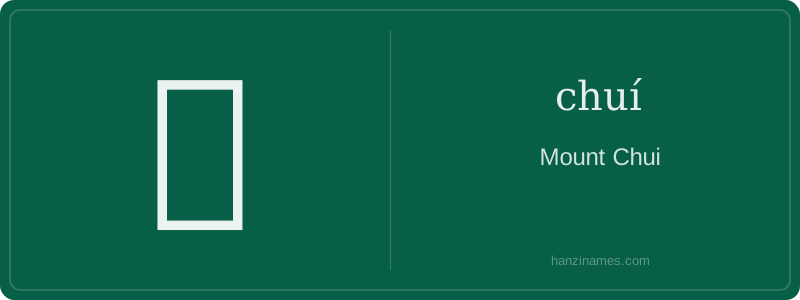
圌 is used almost exclusively in the name of Chui Mountain (圌山, Chuí Shān), a historically strategic hill near Zhenjiang, Jiangsu. Documented since the Tang Dynasty, it featured in military records and Ming-era maritime defense texts due to its position overlooking the Yangtze River. Today, it appears on official maps, local tourism signage, and the name of Chuishan Scenic Area—but never in idioms, literature, or daily speech. No common phrases or idioms contain 圌; it is not taught in schools or tested in language exams.
The character’s origin is unclear and not attested in oracle bone or bronze inscriptions. Its structure (囗 + 耑) suggests an enclosing radical (囗) around 耑—a phonetic component also seen in 端 (duān). However, scholars classify it as a late-character formation, likely created during the Han or Wei-Jin period specifically for this toponym. In practice, most Chinese people encounter 圌 only on road signs near Zhenjiang—or not at all.
The Chinese character 圌 (chuí) is an extremely rare, geographically specific term denoting a particular mountain—Mount Chui—in Jiangsu Province, China. Unlike common nouns for mountains (e.g., 山 shān), 圌 functions almost exclusively as a proper noun and appears almost solely in historical toponyms and local gazetteers. Its usage is highly constrained: it does not occur in modern spoken Mandarin, nor in standard dictionaries like the Xiàndài Hànyǔ Cídiǎn (Contemporary Chinese Dictionary), and is absent from all HSK vocabulary lists.
This character exemplifies how Chinese orthography preserves localized geographical identity—even when linguistic utility fades. Comparable to English place names like 'Ben Nevis' or 'Mount Fuji', 圌 carries no generic semantic weight beyond its referent; it’s not a word you ‘use’ to describe mountains but a fixed label tied to one location. Its rarity underscores how Chinese writing retains archaic or hyper-local terms long after they drop from active speech.
In Western cultural terms, 圌 resembles a ‘toponymic fossil’—akin to Latin-derived geographic names in English (e.g., ‘Cumberland’ or ‘York’) that survive only as place names, stripped of broader lexical function. Just as ‘Oxford’ means nothing outside its referent, 圌 has no meaning beyond Mount Chui. It reflects China’s tradition of encoding landscape memory into script—a practice where writing serves cartographic preservation more than communicative flexibility.
Example Sentences
Common Compounds
Similar Characters — Don't Mix These Up
Your First Step into Chinese Culture: Get a Chinese Name
Every journey into Chinese begins with a name. Use our free Chinese name generator to create a meaningful, personalized Chinese name that fits you perfectly.
Get My Chinese Name →