圞
Character Story & Explanation
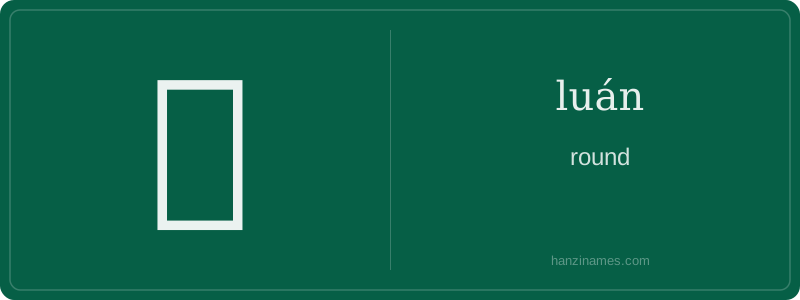
圞 is virtually unused in contemporary spoken or written Mandarin. It does not appear in any HSK vocabulary list, modern dictionaries (e.g., Xiàndài Hànyǔ Cídiǎn), or official language standards. Its only documented usage is in historical artifacts: Tang-Song stele inscriptions, Ming-Qing imperial seals, and Daoist ritual manuscripts — often as a stylistic variant of 圆 or 団. No idioms, set phrases, or colloquial expressions contain 圞.
This character has no verified pictographic origin; it is a late-developed glyph (first attested in Song-era leishu encyclopedias) derived from cursive and seal-script forms of 圆. Its distinctive circular shape reflects deliberate calligraphic stylization—not ancient symbolism. Today, Chinese people encounter it only in museums, academic publications, or decorative typography—never in daily life.
The character 圞 (luán) is a rare, archaic variant meaning 'round' or 'circular', historically used in classical Chinese texts and calligraphy. Unlike the common character 圆 (yuán), 圞 appears almost exclusively in pre-modern contexts — such as Song- and Ming-dynasty seal inscriptions, imperial edicts, and Daoist talismans — where its symmetrical, enclosed form symbolized cosmic wholeness and harmony.
Though visually striking — a perfectly closed, unbroken loop — 圞 is not part of modern standard Chinese orthography. It was excluded from the 1956 and 1964 lists of simplified characters and omitted from the GB2312 and Unicode 1.0 character sets until much later (Unicode 3.0, 1999). Today, it survives mainly in scholarly editions, antique reproductions, and digital fonts designed for historical authenticity.
Its absence from daily use means most native speakers have never encountered 圞 outside calligraphy exhibitions or museum labels. Even advanced learners rarely encounter it in textbooks. Yet its aesthetic power endures: when seen on an old bronze mirror inscription or a Qing dynasty scholar’s seal, 圞 evokes an era where form and meaning were inseparable — where a single stroke could embody the Daoist ideal of cyclical unity and completeness.
Example Sentences
Common Compounds
Similar Characters — Don't Mix These Up
Your First Step into Chinese Culture: Get a Chinese Name
Every journey into Chinese begins with a name. Use our free Chinese name generator to create a meaningful, personalized Chinese name that fits you perfectly.
Get My Chinese Name →