圢
Character Story & Explanation
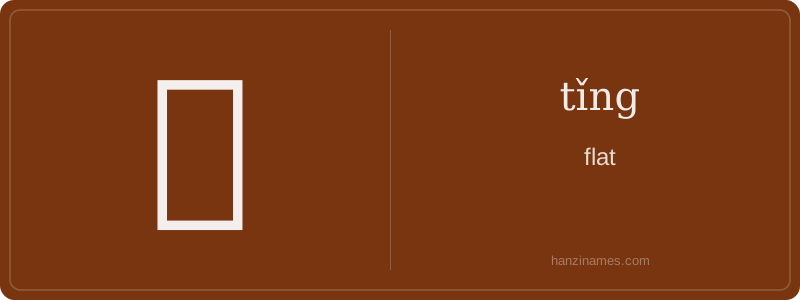
The character 圢 (tǐng) is virtually unused in contemporary spoken or written Mandarin outside of specific toponyms in northern China—particularly in Shanxi, Shaanxi, and Inner Mongolia. It appears in historical land deeds and local gazetteers denoting flat, arable land, but no modern idiom, proverb, or set phrase contains it. The State Council’s 2021 List of Standardized Place Name Characters includes 圢 only in registered village names (e.g., 圢上村 in Lüliang, Shanxi), confirming its status as a geo-lexical relic rather than a functional word.
Unlike pictographic characters such as 日 (sun) or 山 (mountain), 圢 has no verified ancient script form in oracle bone or bronze inscriptions. Its structure combines 土 (earth) and 廷 (courtyard—suggesting open, level space), but this is a later phono-semantic construction, not a primordial pictograph. Today, Chinese speakers encounter it only on rural maps, local government documents, or heritage signage—not in speech or textbooks.
The character 圢 (tǐng) is a rare, specialized Chinese character meaning 'flat' or 'level ground', primarily used in geographical and agricultural contexts. It appears almost exclusively in place names—especially in northern China—where it denotes flat, open land suitable for farming or settlement. Unlike common synonyms like 平 (píng) or 平坦 (píngtǎn), 圢 carries a regional, toponymic weight and is seldom encountered in modern spoken or written Mandarin outside of local signage or historical land records.
Despite its simple semantic core—'flatness'—the character has no presence in the HSK curriculum, nor does it appear in standard dictionaries as a standalone word. Its usage is almost entirely lexicalized within compound toponyms (e.g., 圄圙, though note: 圢 itself is distinct). Linguistically, it belongs to the 'earth' radical category, reflecting its association with terrain and soil—yet it is not classified under the standard 土 (tǔ) radical in modern dictionaries due to its archaic form and limited adoption.
This character exemplifies how Chinese orthography preserves regional linguistic ecology: even characters with low frequency retain cultural resonance in local identity. While you won’t hear 圢 in daily conversation, you might see it carved into a village boundary stone in Shanxi or listed in a county’s civil affairs archive as part of an official hamlet name. Its survival is less about utility and more about cartographic continuity—a quiet anchor in China’s evolving landscape of language and land.
Example Sentences
Common Compounds
Similar Characters — Don't Mix These Up
Your First Step into Chinese Culture: Get a Chinese Name
Every journey into Chinese begins with a name. Use our free Chinese name generator to create a meaningful, personalized Chinese name that fits you perfectly.
Get My Chinese Name →