圩
Character Story & Explanation
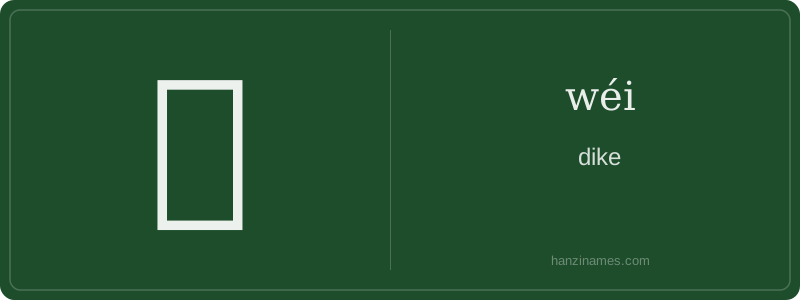
In modern China, 圩 is most commonly encountered in geographical names and flood-control discourse — especially in Anhui, Jiangsu, and Jiangxi provinces. Official documents from the Ministry of Water Resources (e.g., 2020 Yangtze Basin Flood Control Report) repeatedly reference wéi systems as critical infrastructure. The term appears in compound place names like Wéikǒu (‘Dike Entrance’) and is central to local terms such as wéi tián (dike-enclosed farmland), documented in Ming-era agricultural manuals like Nóngzhèng Quánsū.
The character’s origin is not pictographic nor attested in oracle bone or bronze inscriptions. It first appears in seal script during the Han dynasty as a newly coined character for engineered earthworks. Today, Chinese people use it primarily in regional toponyms and water-management contexts — e.g., villagers in Tongling (Anhui) refer to their ancestral farmland as ‘the old wéi’, evoking intergenerational stewardship of diked land.
Our detective begins at the scene: the character 圩 appears in early Chinese dictionaries like the Shuōwén Jiězì (121 CE), classified under the ‘earth’ (土) radical — a clear clue that its meaning is grounded in land and soil. The right component, 九, is not phonetic in the classical sense but likely served as a simplified, stylized marker. Historical texts from the Song and Ming dynasties consistently use 圩 to denote artificial earthen embankments built to reclaim low-lying wetlands — especially in the Yangtze River Delta and Jianghuai region.
Zooming in on pronunciation: wéi is the standard Mandarin reading, used in technical and geographical contexts; xū survives as a regional reading in Wu and Huizhou dialects, preserved in place names like Huǎngqíxū (a historic market town in Anhui). This dual pronunciation reflects China’s linguistic stratification — not an etymological contradiction, but evidence of layered administrative and colloquial usage over centuries.
The six-stroke structure tells its own story: first the earth radical (3 strokes), then the ‘nine’ component (3 strokes) — compact, functional, and unmistakably topographic. Unlike ornate characters born of ritual or poetry, 圩 emerged from hydraulic engineering necessity. Its simplicity belies its significance: every stroke represents human intervention against water — a quiet monument to agrarian resilience in flood-prone regions of eastern China.
Example Sentences
Common Compounds
Similar Characters — Don't Mix These Up
Your First Step into Chinese Culture: Get a Chinese Name
Every journey into Chinese begins with a name. Use our free Chinese name generator to create a meaningful, personalized Chinese name that fits you perfectly.
Get My Chinese Name →