圬
Character Story & Explanation
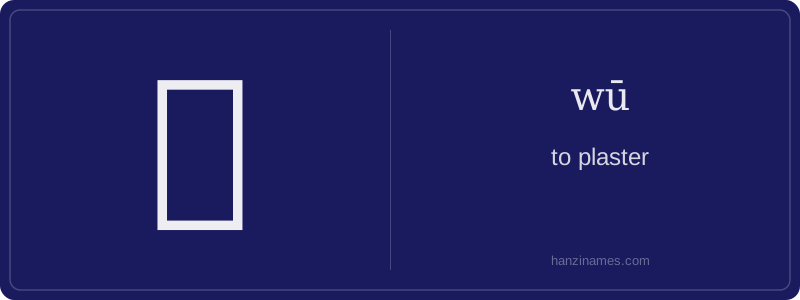
Historically, 圬 appears in classical texts like the *Zuo Zhuan* (c. 4th century BCE) and later in Tang dynasty building manuals, always denoting the craft of applying lime or clay plaster to walls and ceilings. Though rare in modern spoken Mandarin, it persists in construction terminology, official documents on heritage restoration, and idioms like ‘圬者之技’ (the skill of a plasterer), used metaphorically to praise meticulous craftsmanship.
The character is a phono-semantic compound: 土 (tǔ, earth) as semantic radical indicates material domain, while 亏 (kuī, originally meaning 'lack' or 'deficiency') serves as phonetic component—though its sound has shifted to wū over millennia. No oracle-bone or bronze inscriptions survive for 圬; its earliest verified forms appear in Han dynasty bamboo slips related to public works projects.
The character 圬 (wū) embodies a quiet yet essential aspect of Chinese craftsmanship and cosmology: the act of smoothing, sealing, and harmonizing surfaces. In traditional Chinese thought, earth (土, the radical) is one of the Five Phases—stable, nurturing, and foundational. To plaster (圬) is not merely physical labor but an act of bringing order to raw material, transforming rough walls into clean, protective boundaries—a microcosm of cultivating virtue and social harmony.
Unlike Western notions that often separate art from labor, 圬 reflects Confucian respect for skilled manual work. The *Analects* (3.16) praises the master plasterer who ‘does not hide his tools’—a metaphor for integrity in practice. This character subtly links technical precision with moral clarity: a well-plastered wall resists decay, just as cultivated character withstands temptation.
In Daoist and feng shui contexts, plastering also carries symbolic weight—sealing cracks prevents qi leakage, maintaining energetic balance within living spaces. Thus, 圬 is more than a verb; it’s a cultural gesture toward wholeness, containment, and care. Its six-stroke simplicity belies deep resonance: earth shaped by human intention, turning structure into sanctuary.
Example Sentences
Common Compounds
Similar Characters — Don't Mix These Up
Your First Step into Chinese Culture: Get a Chinese Name
Every journey into Chinese begins with a name. Use our free Chinese name generator to create a meaningful, personalized Chinese name that fits you perfectly.
Get My Chinese Name →