圻
Character Story & Explanation
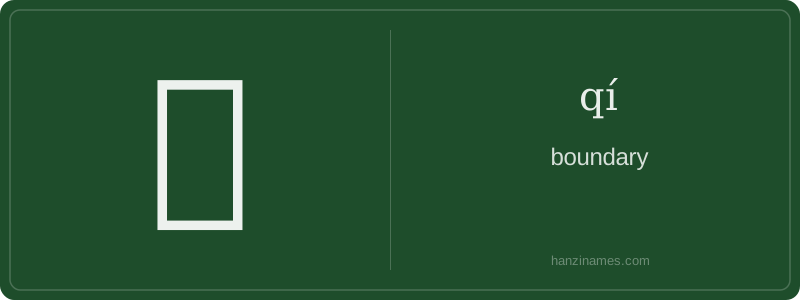
Historically, 圻 appears in classical texts like the *Zuǒ Zhuàn* and *Shūjīng*, consistently denoting the outermost territorial boundary of the royal domain—often paired with ‘服’ (fú, 'sphere of service') as in ‘畿服’ (jīfú), referring to concentric zones of allegiance radiating from the capital. It survives primarily in formal, literary, or toponymic usage—e.g., the rare surname Qí and historical place names like ‘Yángqí’ (now part of Jiangsu). No common idioms feature it today; its modern use is almost exclusively archaic or poetic.
The character is not pictographic. It evolved from seal script forms combining 土 (earth/land) and 千 (qiān, originally a phonetic component, not ‘thousand’). The ‘千’ element provided pronunciation (cognate with qí), while 土 anchored semantic meaning—land as bounded domain. This phono-semantic structure is well-documented in the *Shuōwén Jiězì* (121 CE), China’s earliest dictionary.
At first glance, 圻 (qí) appears simple—a mere seven-stroke character with the earth radical 土—but it opens a profound window into the classical Chinese worldview: land is never just soil; it is sovereignty, order, and cosmic alignment. In ancient China, boundaries were sacred demarcations between realms—the imperial capital’s ‘nine provinces’, the ‘four seas’ surrounding civilization, or the ritual precincts separating human and divine. 圻 embodies this metaphysical geography: not a fence or line on a map, but a charged threshold where authority, cultivation, and harmony converge.
This character reflects Confucian and Zhou dynasty cosmology, where proper territorial boundaries upheld moral and political integrity. To ‘define the 圻’ was to enact virtue—misplaced borders invited chaos, while precise ones signaled benevolent rule. Unlike Western notions of property lines, 圻 implies stewardship: the boundary exists to protect cultivated land (the ‘earth’ radical), not to exclude, but to sustain balance between center and periphery, human effort and natural limits.
Even today, though rare in daily speech, 圻 lingers in literary and ceremonial language as a quiet reminder that space is relational—not neutral, but ethically weighted. Its presence in historical texts like the *Book of Documents* (Shūjīng) and in place names such as Yángqí (a Tang-era prefecture) attests to its enduring resonance. To study 圻 is to recognize how deeply Chinese thought embeds ethics into topography: every border is also a responsibility, every limit an invitation to reverence.
Example Sentences
Common Compounds
Similar Characters — Don't Mix These Up
Your First Step into Chinese Culture: Get a Chinese Name
Every journey into Chinese begins with a name. Use our free Chinese name generator to create a meaningful, personalized Chinese name that fits you perfectly.
Get My Chinese Name →