坆
Character Story & Explanation
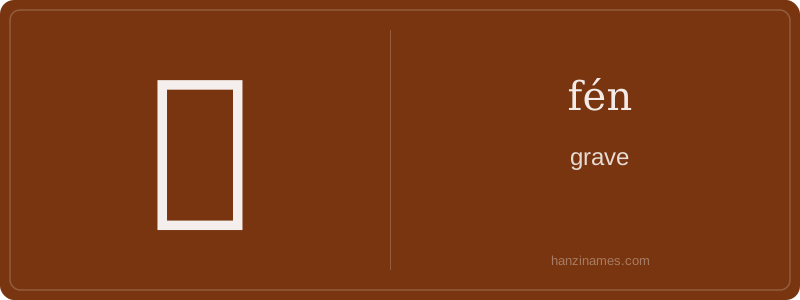
坆 is rarely used in contemporary Mandarin standard speech or writing; it appears mainly in regional dialects (e.g., Fujian and Guangdong), historical documents, and some toponyms (e.g., village names like 坆头村). It occasionally surfaces in literary or poetic contexts to evoke antiquity or solemnity, but it is absent from modern official publications, news media, and HSK vocabulary lists. No major idioms or set phrases feature 坆—it is functionally replaced by 墓, 冢, or 坟 in all standard usage.
The character 坆 is a phono-semantic compound: the radical 土 (tǔ, 'earth') indicates its semantic domain (burial in earth), while the phonetic component 文 (wén) historically approximated its pronunciation. Though not a pictograph, its structure reflects ancient conceptual logic—graves as earthen mounds—and aligns with excavated Han dynasty tomb inscriptions where variant forms of 坆 appear in brick epitaphs.
The Chinese character 坆 (fén) is a relatively rare, semantically specific term meaning 'grave' or 'tomb'—primarily used in formal, literary, or regional contexts. Unlike the more common and neutral word 墓 (mù), 坆 carries archaic or dialectal overtones, especially in southern Chinese varieties like Min Nan and Hakka, where it persists in oral usage and place names. Its limited modern frequency means learners are unlikely to encounter it in HSK materials or beginner textbooks.
Historically, 坆 appears in classical texts and local inscriptions as a variant for burial sites, often reflecting pre-standardized orthographic practices. The alternate reading méi is documented in historical rime dictionaries (e.g., the *Guangyun*), indicating phonological variation across dynasties and regions. This dual pronunciation underscores how Chinese characters can preserve layered linguistic history—even when usage dwindles.
In Western cultural comparison, 坆 aligns most closely with terms like 'sepulcher' or 'barrow'—not everyday 'grave' but evoking solemnity, antiquity, and ritual significance. Like English 'mausoleum' (from Mausolus) or 'cairn' (Celtic origin), 坆 signals cultural specificity: it’s not just a location but a marker of ancestral veneration, geomantic (feng shui) concern, and lineage continuity—values central to traditional Chinese funerary practice but less emphasized in mainstream Western memorial traditions.
Example Sentences
Common Compounds
Similar Characters — Don't Mix These Up
Your First Step into Chinese Culture: Get a Chinese Name
Every journey into Chinese begins with a name. Use our free Chinese name generator to create a meaningful, personalized Chinese name that fits you perfectly.
Get My Chinese Name →