坍
Character Story & Explanation
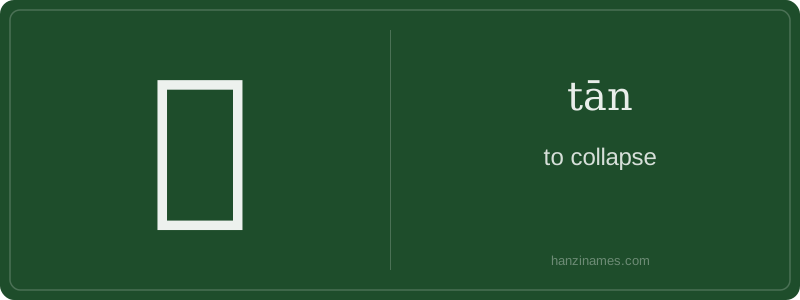
坍 appears frequently in Chinese news reports about natural disasters and infrastructure failures — especially in southern China during typhoon season, where heavy rains cause hillside collapses (山体坍塌, shāntǐ tāntā). It’s also standard in safety regulations and engineering documents. A common phrase is 坍方 (tānfāng), meaning 'landslide' or 'rockfall', widely used in railway and highway maintenance bulletins issued by China’s Ministry of Transport.
The character’s form is not pictographic but phono-semantic: 土 (earth) indicates meaning domain, while 丹 (originally 'cinnabar', later repurposed for sound) gives a rough pronunciation clue. Though 丹 is now pronounced dān, its ancient pronunciation was closer to tān — a documented phonetic borrowing in Middle Chinese. No oracle bone or bronze script forms survive for 坍; it first appears reliably in Song dynasty texts.
Hi students! Today we’re learning 坍 (tān), a 7-stroke character meaning 'to collapse' — like a wall falling down or a building caving in. It’s built from the 土 (tǔ, 'earth/soil') radical on the left, showing it relates to physical structures grounded in earth, and the right side 丹 (dān), which here serves mainly as a phonetic hint (though its sound has shifted over time). This character is not about gradual decline — it’s sudden, dramatic failure.
坍 is used for physical, structural collapse — not metaphorical or emotional breakdowns (for those, we’d use words like 崩 or 毁). Think of landslides, crumbling bridges, or old houses collapsing after heavy rain. It’s a vivid, concrete verb, often paired with nouns like 塌 (tā, also 'collapse') in compound verbs like 坍塌 (tāntā), which means exactly the same thing — reinforcing intensity.
Don’t confuse 坍 with similar-sounding characters like 摊 (tān, 'to spread out') or 滩 (tān, 'beach'). The 土 radical is your anchor: if it’s about earth, soil, or built structures giving way, 坍 is likely the right choice. Practice writing it slowly: 土 (2 strokes) + 丹 (5 strokes) = 7 total. Say 'tān' with a flat first tone — like saying 'tahn' calmly and clearly.
Example Sentences
Common Compounds
Similar Characters — Don't Mix These Up
Your First Step into Chinese Culture: Get a Chinese Name
Every journey into Chinese begins with a name. Use our free Chinese name generator to create a meaningful, personalized Chinese name that fits you perfectly.
Get My Chinese Name →