坎
Character Story & Explanation
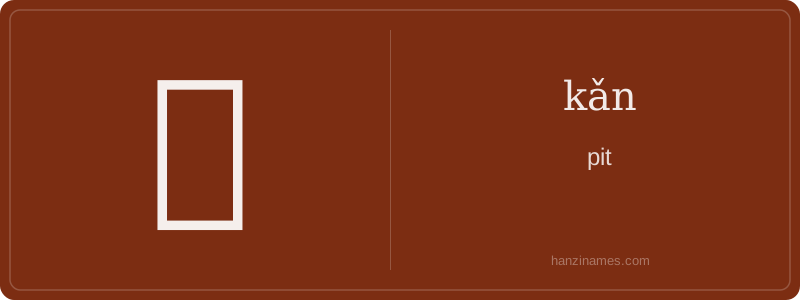
In modern Chinese, 坎 most commonly appears in the idiom 一帆风顺,无惊无坎 (yī fān fēng shùn, wú jīng wú kǎn)—a blessing meaning 'smooth sailing, no shocks or pitfalls', often written on red paper during Lunar New Year. It also features in standardized terms like 水坎 (shuǐkǎn, 'water pit') in rural land management documents and 坎肩 (kǎnjiān, 'vest')—a historical garment named for its 'shoulder pit' cut. The term 难关 (nánguān, 'difficult pass') is sometimes colloquially shortened to 关坎 (guānkǎn) in southern dialects, reflecting its metaphorical extension to life challenges.
The character’s earliest attested form appears in Warring States bronze inscriptions as a pictograph of a rectangular depression in soil—clearly depicting a dug pit with vertical sides and a flat base, matching archaeological evidence of ancient storage pits found at Yangshao and Erlitou sites. No oracle bone form survives, but its consistent shape across bronze and bamboo scripts confirms its origin as a functional, not abstract, sign.
As an archaeologist brushing dust from a Han dynasty bamboo slip, I find 坎 inscribed in clerical script—not as a mere 'pit', but as a geological and cosmological marker. In early Chinese thought, it represented one of the Eight Trigrams (Bāguà), denoting water, danger, and the north—reflecting how physical terrain shaped metaphysical frameworks. Its presence in divination texts suggests pits weren’t just holes in earth, but thresholds between realms: places where spirits gathered or where ritual offerings sank into the unseen.
This character’s radical 土 (earth) anchors it in material reality, while the 口-like top element (originally a simplified depiction of a depression) signals containment and depth. Excavations at Mawangdui revealed 坎 used in military manuals to denote concealed trenches for ambushes—proving its semantic weight extended beyond agriculture into strategy and survival. It was never neutral: a 坎 implied risk, concealment, or transition.
Later, in Tang legal codes and Song land surveys, 坎 appears in cadastral records describing irrigation ditches and flood-control basins—showing its enduring utility in civil engineering. Even today, when hydrologists map groundwater recharge zones in northern China, they still use 坎 in technical reports to designate natural depressions that collect runoff. Its seven-stroke form has remained remarkably stable since the Qin seal script, a testament to how deeply this concept was etched into China’s spatial imagination.
Example Sentences
Common Compounds
Similar Characters — Don't Mix These Up
Your First Step into Chinese Culture: Get a Chinese Name
Every journey into Chinese begins with a name. Use our free Chinese name generator to create a meaningful, personalized Chinese name that fits you perfectly.
Get My Chinese Name →