坨
Character Story & Explanation
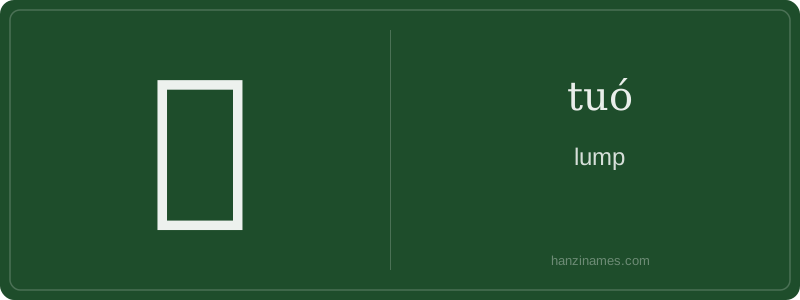
坨 is widely used today as a colloquial measure word for amorphous, cohesive masses — especially in Northern Mandarin. You’ll hear phrases like ‘一坨泥’ (yī tuó ní, 'a lump of mud') or ‘一坨雪’ (yī tuó xuě, 'a heap of snow') in weather reports, cooking shows, or children’s stories. It appears in the Beijing dialect-influenced expression ‘麻烦坨’ (máfan tuó) — slang for ‘a big mess of trouble’. While not in formal idioms, it’s documented in modern dictionaries (e.g., 《现代汉语词典》) as a standard noun and classifier.
The character’s form isn’t ancient — it first appeared in Song dynasty texts as a variant for ‘tuó’ meaning ‘mound’. It’s not pictographic; rather, it’s a later semantic-phonetic compound: 土 (meaning ‘earth-related’) + 它 (sound hint). No oracle bone or bronze script forms exist — it emerged organically to fill a lexical need for describing irregular, clumped matter.
Hi students! Let’s learn 坨 (tuó), an 8-stroke character with the ‘earth’ radical (土) on the left — a clear hint that it relates to landforms. It means ‘mound’, ‘heap’, or ‘lump’ — something rounded and raised, like a small hill or a clump of soil. Though not in the HSK lists (so no official level), it’s common in descriptive writing and everyday speech when talking about physical shapes or quantities of soft or sticky substances.
This character is often used as a measure word — especially for things that naturally form lumps: mud, dough, snow, or even abstract things like trouble! Think of it like English ‘chunk’ or ‘clod’. Its pronunciation tuó has a falling tone (fourth tone), so practice saying it firmly: “tuo̱h” — like cutting off the sound sharply. Don’t confuse it with tuo (tuō, ‘to carry’) — different tone, different meaning!
Visually, 坨 is simple: 土 (earth) + 它 (tā, ‘it’ — here acting phonetically). The right side doesn’t mean ‘it’ in this context; it just helps you pronounce tuó. That’s common in Chinese characters: one part hints at meaning (土), another at sound (它). This ‘semantic-phonetic’ structure appears in over 80% of Chinese characters — so mastering 坨 helps you decode many others too!
Example Sentences
Common Compounds
Similar Characters — Don't Mix These Up
Your First Step into Chinese Culture: Get a Chinese Name
Every journey into Chinese begins with a name. Use our free Chinese name generator to create a meaningful, personalized Chinese name that fits you perfectly.
Get My Chinese Name →