坩
Character Story & Explanation
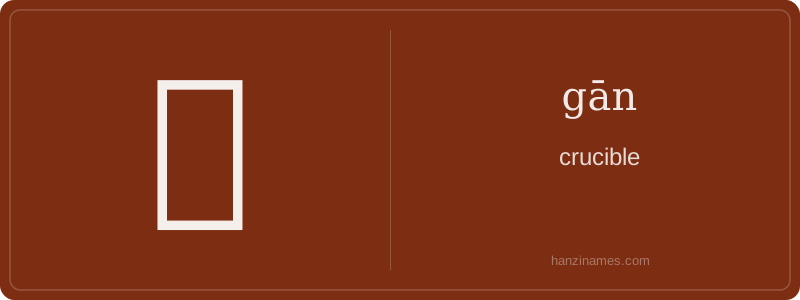
坩 is a technical, low-frequency character in modern Mandarin—rare in daily conversation but essential in scientific, industrial, and educational contexts. It appears in textbooks on metallurgy, lab safety manuals, and chemistry curricula (e.g., the national high school curriculum references 坩埚 for high-temperature experiments). You’ll find it in compound terms like 坩埚炼钢 ('crucible steelmaking'), a documented historical process used in China since the Han dynasty and revived in 20th-century industrial reports.
The character is not pictographic nor attested in oracle bone or bronze inscriptions. Its earliest verified appearance is in Song-dynasty (960–1279) technical dictionaries like Jiǎnzhāi Yìlù, where it’s defined explicitly as a ‘clay vessel for melting metals’. Today, Chinese students encounter it in chemistry labs when handling porcelain crucibles—and teachers write 坩埚 on whiteboards during lessons on thermal decomposition.
Our detective begins at the scene: the character 坩 (gān) appears in early Chinese technical texts as a specialized term for a heat-resistant vessel—specifically, a crucible used in metallurgy and chemistry. Its radical 土 (tǔ, 'earth') immediately signals material origin: crucibles were traditionally made from refractory clay or fired earth, not metal. This grounding in earthenware distinguishes it from metal containers like 鍋 (guō, 'pot') or 缸 (gāng, 'jar'), anchoring meaning through composition.
Zooming in on the right-hand component, 甘 (gān, 'sweet'), is phonetic—not semantic. Though 'sweet' seems incongruous with 'crucible', this is classic phono-semantic compounding: 甘 provides the pronunciation gān while contributing no literal meaning. Such pairings are common in Chinese characters; here, it’s purely a sound cue, like using 'knight' to spell 'night'. No sugar is involved—just historical phonetic convenience.
The eight-stroke structure reveals disciplined craftsmanship: 土 (3 strokes) forms the stable base, while 甘 (5 strokes) sits precisely atop it—mirroring how a crucible rests solidly on a furnace. Its stroke order (horizontal, vertical, horizontal for 土; then the layered strokes of 甘) reflects functional hierarchy: foundation first, then form. This isn’t decorative calligraphy—it’s structural logic encoded in ink, echoing the very engineering principles crucibles embody.
Example Sentences
Common Compounds
Similar Characters — Don't Mix These Up
Your First Step into Chinese Culture: Get a Chinese Name
Every journey into Chinese begins with a name. Use our free Chinese name generator to create a meaningful, personalized Chinese name that fits you perfectly.
Get My Chinese Name →