坪
Character Story & Explanation
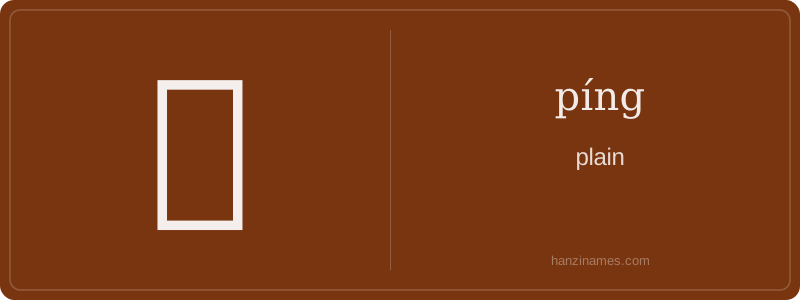
In modern Chinese, 坪 is most widely used today in Taiwan and Okinawa (via Japanese influence) as a traditional unit of area — 1 坪 ≈ 3.3058 m² — especially in real estate listings, property deeds, and housing ads. It remains legally recognized in Taiwan’s land registry system and appears in phrases like ‘建坪’ (jiàn píng, 'built-up area') and ‘地坪’ (dì píng, 'floor area'). Though rare in mainland China (which uses square meters), it persists in historical documents and regional dialects of Fujian and Guangdong.
The character is not pictographic nor attested in ancient scripts like oracle bone or bronze inscriptions. It first appeared in standardized dictionaries during the late imperial era (e.g., Kangxi Dictionary, 1716), explicitly defined as 'a flat expanse of land' and 'a unit of land area'. Its form is purely phono-semantic: 土 (radical, meaning 'earth') + 平 (phonetic component and semantic reinforcement meaning 'level').
Our detective work begins at the scene: the character 坪 (píng), an 8-stroke glyph with the earth radical 土 on the left. At first glance, it’s deceptively simple — but like all well-crafted clues, its structure reveals intent. The right side, 平 (píng), means 'level' or 'flat', and when fused with 土 ('earth' or 'soil'), the compound visually declares: *level ground*. This isn’t poetic license — it’s semantic engineering: a plain is literally leveled earth.
Tracing its historical footprints, 坪 appears reliably in Tang and Song dynasty texts as a unit of land measurement — especially in southern China and Taiwan — where flat, arable plots were scarce and valuable. Unlike abstract geographical terms, 坪 was practical: a surveyor’s tool, a tax assessor’s notation. Its stability across centuries suggests functional necessity, not philosophical abstraction. No oracle-bone or bronze inscriptions bear this character; it emerged later, calibrated for agrarian bureaucracy.
The radical 土 anchors it in material reality — soil you can walk on, till, or build upon. Meanwhile, 平 contributes phonetic *and* semantic weight: it both sounds like 坪 (píng) and reinforces the core idea of horizontal uniformity. This dual role — sound + meaning — is classic phono-semantic compounding, the hallmark of over 90% of Chinese characters. So 坪 isn’t just *a* plain — it’s *the* plain defined by human perception: flat enough to measure, level enough to matter.
Example Sentences
Common Compounds
Similar Characters — Don't Mix These Up
Your First Step into Chinese Culture: Get a Chinese Name
Every journey into Chinese begins with a name. Use our free Chinese name generator to create a meaningful, personalized Chinese name that fits you perfectly.
Get My Chinese Name →