坫
Character Story & Explanation
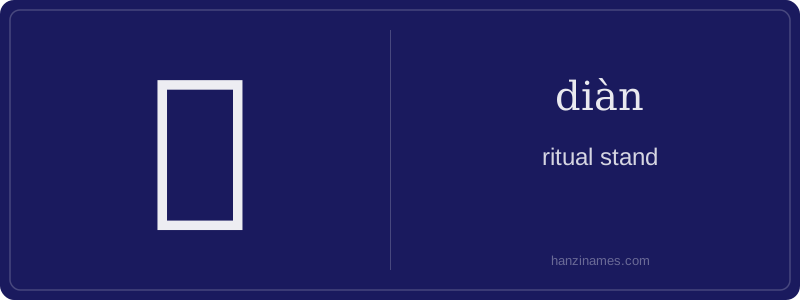
坫 is virtually unused in modern spoken or written Mandarin outside academic, archaeological, or classical text contexts. It appears in pre-Qin ritual manuals like the Book of Rites (Lǐjì) describing ceremonial layouts—for example, specifying that the ‘eastern 坫’ held wine vessels during ancestral rites. No common idioms or modern phrases contain it; even native speakers rarely encounter it outside specialized study.
The character is a phono-semantic compound: 土 (tǔ, ‘earth’) as semantic radical indicates material/function, while 占 (zhān) serves as phonetic component (though pronunciation shifted from *zhān* to *diàn* over time—a documented phonological change in Middle Chinese). Its form has remained stable since seal script, with no pictographic origin; it was never a drawing of a platform but a constructed logograph reflecting ritual taxonomy.
The Chinese character 坫 (diàn) is a rare, classical term referring to a small earthen or stone platform used in ancient Chinese ritual ceremonies—specifically to hold ceremonial wine vessels like goblets (zūn or guī). It reflects the highly codified spatial and symbolic order of Zhou dynasty (c. 1046–256 BCE) rites, where placement signified hierarchy and reverence. Though obsolete in daily speech, 坫 survives in historical texts and scholarly discourse on Confucian ritual architecture.
Unlike Western altar tables or communion stands, the 坫 was not for sacrifice itself but for dignified presentation—emphasizing stillness, elevation, and separation from the ground as markers of sacred intent. Its 土 (earth) radical signals its material origin: compacted soil or low masonry, distinguishing it from wooden altars (zhān) or bronze ritual stands (jī). This subtle functional specificity highlights how Chinese ritual vocabulary encodes precise material and ceremonial logic.
In comparative cultural terms, the 坫 resembles a Japanese *kamidana* base (though smaller and non-domestic) or a Greek *bothros*’s raised counterpart—but neither matches its strict liturgical function in ancestral worship. Modern English lacks a direct equivalent; 'ceremonial goblet stand' is descriptive but unwieldy. Its rarity underscores how deeply embedded such objects were in a vanished performative world—preserved only in lexicons and archaeological reconstructions of Zhou-era ritual compounds like those at Qufu’s Confucius Temple grounds.
Example Sentences
Common Compounds
Similar Characters — Don't Mix These Up
Your First Step into Chinese Culture: Get a Chinese Name
Every journey into Chinese begins with a name. Use our free Chinese name generator to create a meaningful, personalized Chinese name that fits you perfectly.
Get My Chinese Name →