坱
Character Story & Explanation
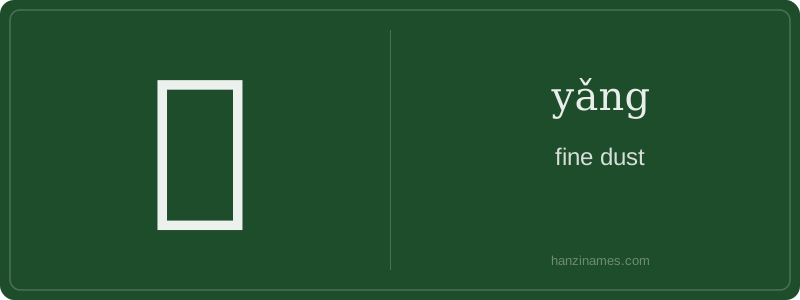
坱 appears almost exclusively in classical and literary contexts—not daily speech. It features in pre-modern texts like the Guangyun (1008 CE) rhyme dictionary and appears in poetic lines by Tang poet Li He and Song scholar-official Ouyang Xiu, always describing suspended, fine, often atmospheric dust. No modern idioms or set phrases contain it; it has no presence in spoken Mandarin, news, or social media. It survives solely in philological study, classical poetry anthologies, and historical linguistics research.
The character is a phono-semantic compound: the left side 土 (tǔ, 'earth') is the semantic radical, indicating material origin; the right side 央 (yāng) provides phonetic approximation (yǎng vs. yāng). This structure emerged during the Han–Wei transition period, reflecting standardization of rare lexical items for precise literary description—not pictographic origins.
As an archaeologist brushing dust from a Tang dynasty stele, I first encountered 坱 not in a dictionary—but clinging to the margins of a 9th-century poetic commentary. Its form—earth radical (土) fused with a phonetic component (央)—reveals a deliberate, late-classical construction: not an ancient oracle-bone glyph, but a refined lexical tool for describing the subtlest particulates—dust that hangs motionless in sunbeams, drifts from crumbling murals, or settles on lacquerware after centuries underground.
This character embodies a linguistic precision rare in early Chinese: it doesn’t mean ‘dirt’ or ‘soil’, but specifically *aerial fine dust*—the kind that blurs horizons in desert winds or clouds inkstone water when ground too vigorously. Unlike common dust characters like 尘 (chén), 坱 carries a poetic and almost tactile weight, evoking suspension, impermanence, and quiet accumulation—concepts deeply resonant in Daoist and Chan Buddhist textual layers unearthed from Dunhuang manuscripts.
Its rarity is telling: absent from all HSK lists, modern dictionaries list it as literary or archaic. Yet its survival proves that classical Chinese preserved semantic nuance even for ephemeral phenomena. When we find 坱 in Song dynasty poetry or Ming encyclopedias, it’s never accidental—it marks a deliberate aesthetic choice, like selecting a specific pigment for a scroll: not just ‘dust’, but *the dust that breathes silence*.
Example Sentences
Common Compounds
Similar Characters — Don't Mix These Up
Your First Step into Chinese Culture: Get a Chinese Name
Every journey into Chinese begins with a name. Use our free Chinese name generator to create a meaningful, personalized Chinese name that fits you perfectly.
Get My Chinese Name →