坴
Character Story & Explanation
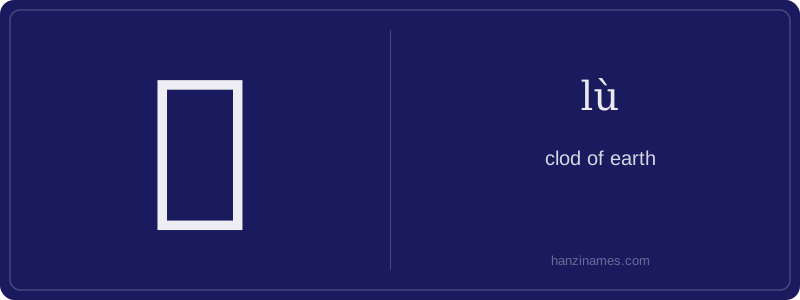
坴 is extremely rare in contemporary Standard Mandarin and does not appear in any HSK level, modern dictionaries (e.g., Xiàndài Hànyǔ Cídiǎn), or common idioms. It is absent from the GB2312 and GB18030 character sets used in digital communication. Documented usage is limited to pre-modern agricultural texts and regional gazetteers—e.g., the 18th-century Sichuan provincial gazetteer mentions 坴 as a local term for 'fist-sized soil clods' in terrace-field maintenance. No standardized idiom contains it.
The character is a logical compound: 土 (earth) + 田 (field, originally a pictograph of irrigated plots). Its structure reflects agrarian observation—not a pictograph of a clod itself, but a conceptual fusion of earth and cultivated land. In practice today, native speakers almost never write or say 坴; instead, they use colloquial terms like 土块 (tǔkuài) or 泥团 (nítuán) for 'clod of earth'.
Imagine stepping barefoot onto freshly turned soil in a rural Sichuan village after spring rain—the earth soft, damp, and fragrant. There, beneath your toes, you feel small, compact lumps of soil: not dust, not mud, but distinct, palm-sized clods—each one a natural unit of earth held together by moisture and clay. This tangible, humble form is precisely what 坴 (lù) names: a discrete, solid chunk of earth, unrefined and elemental.
The character 坴 belongs to the ‘earth’ (土) radical family, anchoring it firmly in the physical world of soil, land, and agriculture. Its eight strokes combine 土 (3 strokes) with 田 (5 strokes), visually suggesting cultivated earth—fields divided into plots. Though rare in modern daily speech, 坴 appears in classical texts and regional dialects to denote unplowed, naturally aggregated soil—emphasizing texture and cohesion over volume or weight.
In Chinese linguistic ecology, 坴 exemplifies how characters preserve agrarian precision: unlike generic terms like 土 (soil) or 泥 (mud), 坴 specifies *form*—a self-contained, hand-holdable mass. It reflects an ancient observational sensitivity: farmers, potters, and builders all needed words to distinguish friable loam from dense clods. Today, its rarity makes it a quiet testament to China’s deep-rooted soil literacy—a lexical relic still legible in place names and historical farming manuals.
Example Sentences
Common Compounds
Similar Characters — Don't Mix These Up
Your First Step into Chinese Culture: Get a Chinese Name
Every journey into Chinese begins with a name. Use our free Chinese name generator to create a meaningful, personalized Chinese name that fits you perfectly.
Get My Chinese Name →