坻
Character Story & Explanation
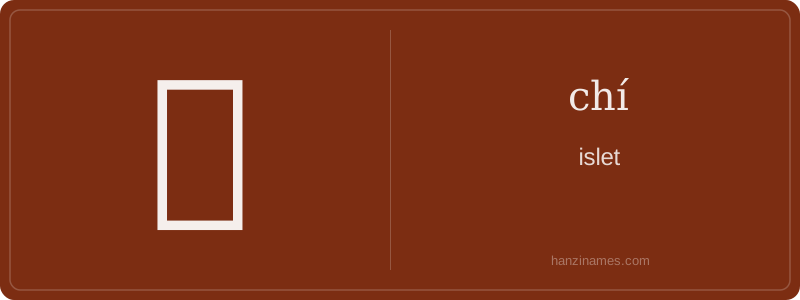
坻 appears most frequently in classical Chinese poetry and historical geography texts—for example, in the Classic of Poetry (《诗经》), where '宛在水中坻' ('She seems to stand upon a waterside islet') evokes elusive beauty and quiet longing. In modern usage, it survives almost exclusively in literary contexts, place names (e.g., 坻阳镇 Dǐyáng Zhèn in Henan—though pronounced dǐ here), and formal compound words like 水中坻 ('river-islet'). It is absent from HSK lists and daily speech.
The character is a phono-semantic compound: 土 (tǔ, 'earth/soil') as the semantic radical signals land-related meaning, while 氐 (dī, originally a phonetic component) hints at pronunciation. Though 氐 itself means 'base' or 'foundation', the character 坻 was standardized early in seal script for its aquatic-landform sense—not as a pictograph, but as a functional composite rooted in ancient lexicography.
坻 (chí) is a poetic, literary character meaning 'small islet' or 'shoal'—a landform emerging from water, often in rivers or lakes. Unlike common geographical terms like 岛 (dǎo, 'island'), 坻 evokes quiet, natural solitude and appears predominantly in classical poetry and formal writing. Its rarity in modern spoken Chinese reflects its elevated register: it’s the kind of word you’d find in Tang dynasty verses or landscape essays, not weather reports or subway announcements.
In Western cultural equivalents, 坻 aligns closely with English 'eyot' (a small, often tree-covered river island in British English) or 'ait', both archaic yet precise terms used in literature and local geography—especially along the Thames. Like these words, 坻 carries connotations of tranquility, isolation, and timelessness; it suggests a place where humans pause, reflect, or observe nature—not settle or develop.
This character also subtly embodies Daoist and Confucian ideals: a stable, grounded presence (via the 土 radical) amid flowing change (water context), echoing metaphors like 'the wise man delights in water' (《论语》). Its dual pronunciation—chí (literary, islet) and dǐ (rare, 'base/foot of a hill')—reflects semantic branching over centuries, though only chí remains in active lexical use today.
Example Sentences
Common Compounds
Similar Characters — Don't Mix These Up
Your First Step into Chinese Culture: Get a Chinese Name
Every journey into Chinese begins with a name. Use our free Chinese name generator to create a meaningful, personalized Chinese name that fits you perfectly.
Get My Chinese Name →