坽
Character Story & Explanation
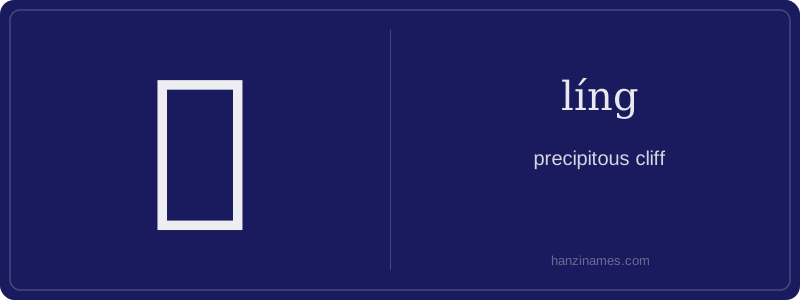
坽 is exceptionally rare in modern daily usage. It does not appear in the HSK syllabus, contemporary textbooks, or common media. Verified occurrences are limited to historical geographical records (e.g., Qing-dynasty gazetteers), classical poetry referencing southern Fujian or Guangdong topography, and a few modern place names — notably the village of 坽头 (Língtóu) in Guangdong Province, documented in official civil affairs databases. No idioms or set phrases containing 坽 exist in standard dictionaries like the Xiandai Hanyu Cidian.
The character is not pictographic; it is a phono-semantic compound: the left side 土 (tǔ, 'earth/soil') is the semantic radical indicating terrain, while the right side 令 (lìng) serves as the phonetic component. Its earliest attestation is in the Kangxi Dictionary (1716), defined succinctly as 'steep cliff' — confirming its longstanding, technical geographic function rather than mythological or oracle-bone origin.
The Chinese character 坽 (líng) is a rare, specialized term meaning 'precipitous cliff' — emphasizing verticality, steepness, and natural grandeur. Unlike common landscape words like 山 (shān, 'mountain') or 崖 (yá, 'cliff'), 坽 conveys an almost awe-inspiring, perilous drop, often evoking geological immensity rather than mere elevation. It appears primarily in classical poetry, geographical texts, and regional place names, reflecting China’s deep literary tradition of using precise, evocative vocabulary to capture nature’s majesty.
In classical Chinese aesthetics, cliffs like those described by 坽 symbolize resilience, solitude, and the sublime — similar to how Romantic poets used 'precipice' or 'crag' to signify existential confrontation with nature’s power. The character’s rarity underscores its elevated register: it’s not for casual description but for poetic gravity or technical geomorphology. Its phonetic-semantic structure hints at both sound (令 lìng as phonetic component) and meaning (土 tǔ radical for earth/land), anchoring the idea in physical terrain.
Western equivalents include 'precipice', 'sheer cliff', or 'abrupt escarpment' — terms that stress vertical relief and danger. Yet unlike English, where 'cliff' suffices in most contexts, Chinese retains lexical specificity: 坽 implies a *natural*, *unbroken*, *near-vertical* rock face — closer to the French 'falaise verticale' or German 'senkrechter Felsabbruch'. This precision reflects how traditional Chinese cartography and literature classified landforms with nuanced terminology long before modern geology.
Example Sentences
Common Compounds
Similar Characters — Don't Mix These Up
Your First Step into Chinese Culture: Get a Chinese Name
Every journey into Chinese begins with a name. Use our free Chinese name generator to create a meaningful, personalized Chinese name that fits you perfectly.
Get My Chinese Name →