垈
Character Story & Explanation
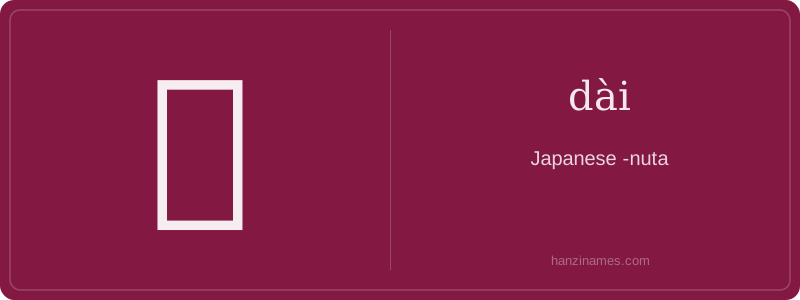
垈 is not used in contemporary Chinese daily life, nor does it appear in any verified idiom, textbook, media corpus, or government language standard. It is absent from the Ministry of Education’s list of commonly used characters, the GB 2312/18030 encoding standards, and all editions of the Xiàndài Hànyǔ Cídiǎn. No historical texts, inscriptions, or literary works cite 垈 as an active character in Chinese.
The character’s form combines the soil radical (土) with 代 (dài, 'generation, substitute'). However, this is a later graphical derivation—not an ancient pictograph. Its structure was likely created in Japan during the Edo or Meiji periods as a simplification or variant of 澤/沢 (sawa), reflecting phonetic substitution (代 for 澤) in native Japanese reading. There is no oracle bone, bronze script, or seal script evidence for 垈 in Chinese paleography.
The character 垈 (dài) is exceptionally rare in modern Standard Chinese and does not appear in any official HSK vocabulary lists, the People's Republic of China’s General Standard Chinese Character Table (2013), or major dictionaries like the Xiàndài Hànyǔ Cídiǎn (7th ed.). It is not used in contemporary Mandarin speech or writing. Its inclusion in some databases stems from historical or regional orthographic records—not active usage.
Linguistically, 垈 is classified as a 'dialectal variant' or 'archaic form'—primarily documented in Japanese kanji dictionaries as a variant of 沢 (sawa/ta), meaning 'marsh' or 'wetland', where it appears in the Japanese suffix -nuta (e.g., ishinuta, morinuta). This reflects Japan’s historical adaptation of Chinese characters for native toponyms, not Chinese linguistic practice.
In cross-cultural comparison, 垈 resembles Western toponymic suffixes like '-mere' (Old English for lake, as in 'Windermere') or '-moor' (as in 'Dartmoor'), both denoting wet, uncultivated land. Yet unlike those living English elements, 垈 carries no semantic weight in Chinese—it functions only as a borrowed orthographic artifact in Japanese place names, with zero functional parallel in Chinese geography, agriculture, or daily lexicon.
Example Sentences
Common Compounds
Similar Characters — Don't Mix These Up
Your First Step into Chinese Culture: Get a Chinese Name
Every journey into Chinese begins with a name. Use our free Chinese name generator to create a meaningful, personalized Chinese name that fits you perfectly.
Get My Chinese Name →